



The first day of December 2025 has brought a striking surge in solar activity, prompting renewed scientific attention to the relationship between the Sun’s magnetic behavior and the technological systems that depend on stable conditions in near-Earth space. An unexpected With an unusually large and magnetically complex sunspot group now facing Earth, researchers and monitoring centers are intensifying observations as multiple active regions display signs of further flare potential. This combination of sudden eruption and large-scale magnetic volatility has positioned the current solar developments as a significant focus for space weather forecasting.
Why did a small sunspot trigger such a powerful solar flare
The X2-class flare recorded at 0249 UTC on 1 December 2025 demonstrated how even modest-looking solar regions can give rise to powerful bursts of radiation. Rather than erupting from the vast sunspot group in the southern hemisphere, the flare originated from northern sunspot 4295, a small and previously unremarkable feature. This kind of eruption reveals the unpredictable nature of magnetic tension building within the Sun’s atmosphere, where reconnection events can release stored energy with little prior indication on the visible surface.As the radiation pulse reached Earth, rapid ionisation in the upper atmosphere caused a shortwave radio blackout centered over Australia. Such blackouts occur when intense radiation disrupts normal ionospheric layering, reducing its ability to reflect high-frequency radio signals used for long-distance communication. Early readings also suggest that a coronal mass ejection may have accompanied the flare, although confirmation awaits detailed data from coronagraph instruments. Should the CME travel Earthward, it may introduce additional geomagnetic disturbance and charged particle influx, with possible implications for satellites, navigation accuracy and power infrastructure.
Why experts expect additional strong flares this week
Monitoring centers have indicated that the flare from sunspot 4295 is unlikely to be an isolated event. Several regions currently rotating across the solar disc hold sufficient magnetic complexity to trigger additional high-energy eruptions. Forecasters have paid particular attention to sunspot complex 4294-96, which contains rapidly evolving polarity boundaries and an unstable configuration known as beta gamma delta. This type of magnetic arrangement is commonly associated with the most intense solar flares recorded, increasing expectations that further X-class events may follow.A research investigation into the behavior of magnetically complex sunspot groups, published on SpaceWeather.com has shown that regions exhibiting rapid changes in polarity distribution are prone to releasing energy in sudden bursts. These findings align closely with the conditions now seen within the giant 4294-96 complex, which continues to show signs of magnetic stress as it faces Earth. Any flare emerging from such a region would be geoeffective, meaning that its radiation and particle emissions would encounter Earth directly. For sectors that rely on high-frequency communication or satellite stability, this raises the likelihood of intermittent disturbances over the coming days.
How the massive 4294-96 sunspot group became the center of attention
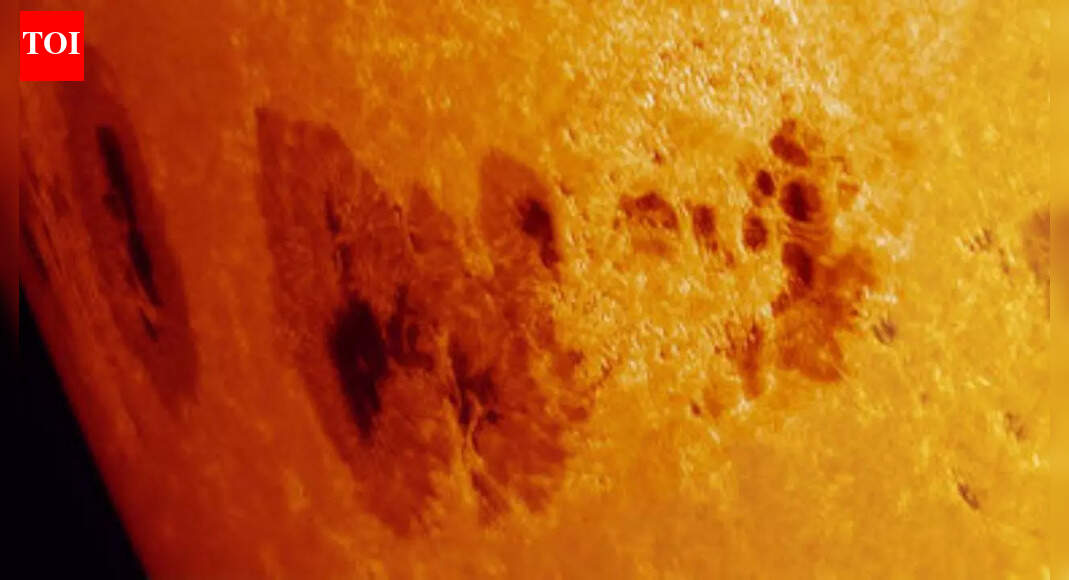
What distinguishes the current solar situation is the sheer size of the 4294-96 sunspot complex. Measuring roughly 180,000 kilometers across, it is one of the largest and most visually striking formations documented within the past ten years. Several individual dark cores are significantly larger than Earth, producing a structure that is easily visible through properly filtered telescopes, even for amateur observers. Its shape, spread and magnetic configuration mark it as a major driver of the heightened solar conditions noted at the start of December.NASA’s Perseverance rover recorded images of this sunspot while it was still days away from rotating into Earth’s view, capturing the formation through the dusty skies of Jezero Crater on Mars. Once the group oriented toward Earth, its magnetic properties became clearer, revealing a landscape of intertwined fields that can store and release substantial energy. Sunspots form where strong magnetic fields suppress convection, creating cooler, darker regions on the solar surface. In complexes of this magnitude, magnetic loops can twist and reconnect in ways that release energy as radiation or plasma. The presence of such an extensive and volatile region provides the backdrop against which the latest X-class flare unfolded and contributes to the high probability of further activity.
How the December flare is affecting radio, satellites and the ionosphere
The effects of the 1 December flare illustrate how solar conditions can ripple into technologies that depend on atmospheric stability. The radio blackout over Australia highlighted the vulnerability of high-frequency communication paths when the ionosphere undergoes sudden change. If the suspected CME is confirmed and directed toward Earth, the additional influx of charged particles may elevate the density of the near-Earth environment, influencing satellite drag and creating operational pressure for spacecraft in lower orbits. Enhanced geomagnetic disturbance could also interact with long conductors within power grids, although the extent of such effects would depend on the strength and orientation of the approaching solar material.As December unfolds, the combined presence of an unexpectedly active northern sunspot and a vast, magnetically stressed southern complex has placed space weather forecasters in a heightened observational posture. Continuous data from solar observatories and orbiting spacecraft will support the effort to track flare probabilities and anticipate any geomagnetic responses that may follow.Also Read | How Africa may become Earth’s next ocean basin in 5 to 10 million years giving birth to a new ocean
