



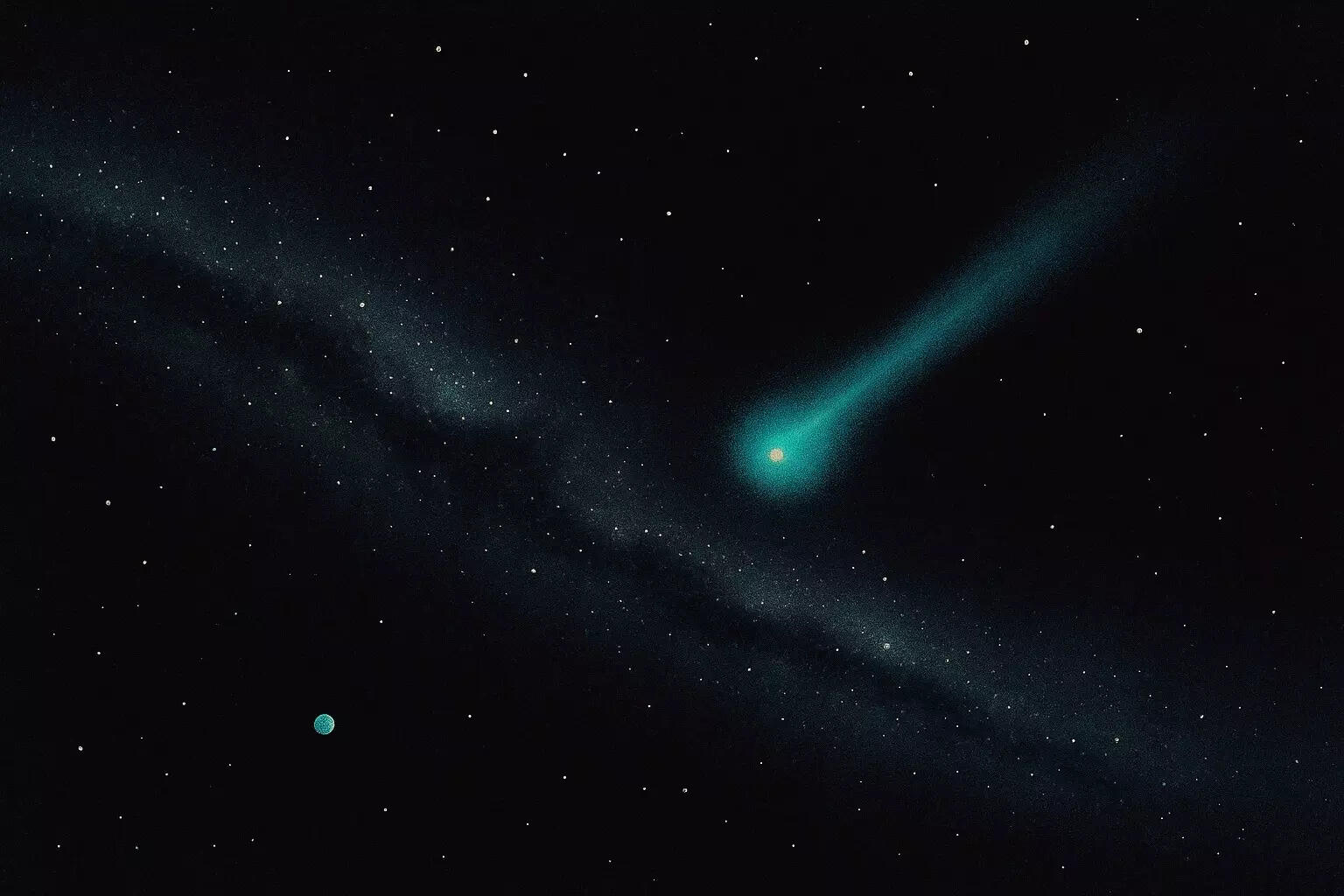
The year 2025 has brought us a rare cosmic visitor. 3I/ATLAS is only the third confirmed interstellar object ever detected — after ʻOumuamua in 2017 and Comet Borisov in 2019. Discovered on July 1, 2025, by the ATLAS survey telescope, this object is on a hyperbolic orbit, meaning it came in from outside our Sun’s gravitational grasp and will depart the Solar System forever. In telescope images it appears as a faint, blue-green dot moving slowly among the stars. At its brightest it is only about magnitude 12–14 — far too dim to see with the naked eye or binoculars. Rather than a blazing cometary firework, 3I/ATLAS will seem like a tiny, silent speck in the pre-dawn sky.Even NASA’s Hubble Space Telescope sees 3I/ATLAS as a faint blue blur against the starfield. Telescopes must strain to detect it: at magnitude ~12–14 it’s visible only to large instruments like Hubble or the James Webb Space Telescope. It glows by reflected sunlight and a hint of greenish gas, but not with a dramatic tail. Observatories report only a subtle greenish-blue coma of carbon compounds. In practical terms, 3I/ATLAS looks like a dim, slow-moving dot — an ancient traveler merely whispering its presence. It is not a naked-eye spectacle, nor will it brighten enough for binoculars. Instead, this comet’s mystique lies in its origin: it is a messenger from the void between the stars.

Why is it called 3I/ATLAS?
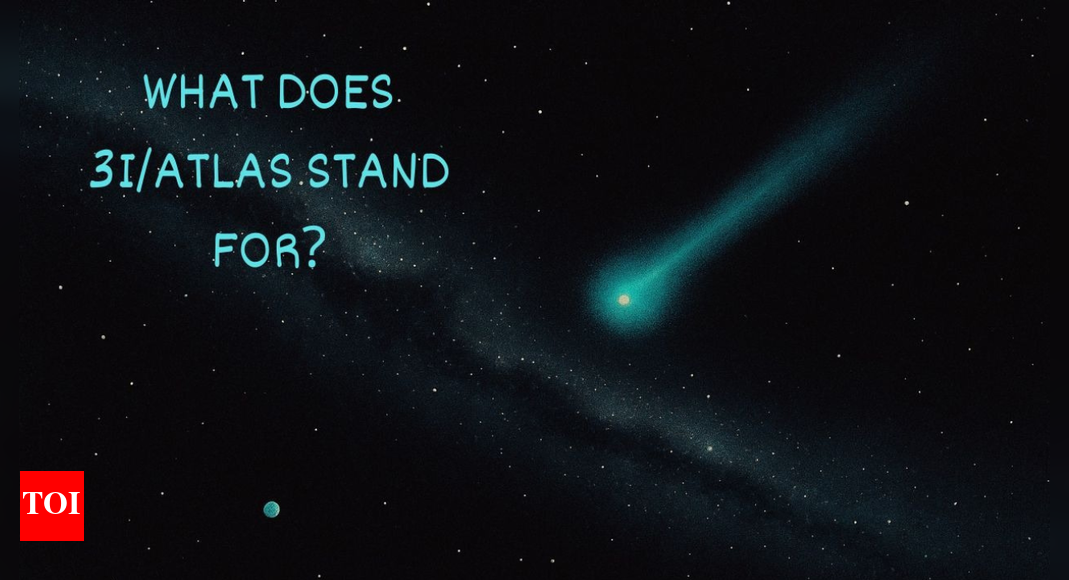
3I/ATLAS stands for the third interstellar object discovered by the Asteroid Terrestrial-impact Last Alert System (ATLAS) survey. The “3” indicates that it is the third such object identified, while the “I” stands for “interstellar,” signifying that it originated from beyond our solar system. “ATLAS” refers to the survey that made the discovery, which is designed to detect near-Earth objects and potential impact threats.
A Stranger from Beyond
3I/ATLAS began its journey light-years away. Its discovery by ATLAS (the Asteroid Terrestrial-impact Last Alert System) immediately flagged its odd nature. Even at 3.5 AU from Earth it was moving at roughly 61 km/s — far faster than any comet bound to the Sun. Follow-up observations showed its path was clearly hyperbolic: it would swing into the inner Solar System just once and then head back out into the galaxy. In other words, 3I/ATLAS is not a local comet at all but a wayfarer from another star system. The International Astronomical Union promptly gave it the designation “3I,” marking it as the third confirmed interstellar object.Its trajectory carries it between the orbits of Earth and Mars. Its closest approach to the Sun (perihelion) will occur around October 30, 2025, at roughly 1.35 AU — just inside Mars’ orbit. Around mid-December 2025 it will come to within about 1.8 AU of Earth, still perfectly safe from any risk of impact. After that brief visit, the comet will recede forever, speeding back into interstellar space. This is a once-in-a-lifetime encounter: once 3I/ATLAS leaves, it will never return.Astronomers around the globe have been busy planning observations of this fleeting guest. Spacecraft at other planets even had “ringside seats” to its flyby — Mars orbiters saw it pass within 0.19 AU of Mars on October 3, 2025, and spacecraft near Jupiter will observe it at perihelion. Every image and spectrum is precious, because once 3I/ATLAS rounds the Sun, it will fade quickly. By mid-November 2025 it should reappear low in the eastern pre-dawn sky, giving northern observers a short window to catch it.
A Time Capsule of Another World
Despite its dimness, 3I/ATLAS is scientifically priceless. It is literally material from another solar system — a physical sample of ice and dust that formed around a distant star long ago. Spectroscopy has already revealed its unusual chemistry. In August 2025, the Gemini South telescope imaged its coma and found signatures of carbon dioxide, hydrogen cyanide, and atomic nickel. These give the comet its subtle greenish-blue glow. Measurements show 3I/ATLAS has more CO₂ and nickel than typical solar comets, suggesting it condensed in a very cold, carbon-rich nebula far from its parent star.Spectral observations from space telescopes reinforce this picture. NASA’s Swift Observatory detected hydroxyl (OH) in ultraviolet light, a fingerprint of water being broken down — the first clear water signature ever seen in an interstellar object. And the James Webb Space Telescope has seen abundant CO₂ ice and only a bit of water vapor. Together, the chemical clues suggest 3I/ATLAS is a pristine relic from the distant past. Its orbit hints it may hail from the Milky Way’s thick disk; if so, its journey through the galaxy could have lasted around 7 billion years — roughly twice the age of Earth. In that sense, it may be the oldest comet astronomers have ever encountered.These observations are like opening a time capsule. The nucleus, perhaps less than a kilometer across, is cloaked in a coma of exotic ices and dust. Every molecule detected — carbon compounds, water fragments, nickel atoms — was forged in some other solar system. By comparing them to familiar comets, scientists can reconstruct the conditions in 3I/ATLAS’s home nebula. Detecting water or its proxy in an interstellar comet is like reading a note from another planetary system. In short, 3I/ATLAS lets us sample alien chemistry using Earth-bound tools.
Catching a Fleeting Ghost
For amateur stargazers, the message is: prepare to look carefully. The comet will emerge from behind the Sun in November 2025 and climb very slowly into the dawn sky. Observers must watch about 1–2 hours before sunrise, when the sky is still dark. Only large amateur telescopes — about 8–10 inches in aperture or bigger — under truly dark, rural skies will have a chance. Even then, 3I/ATLAS will look like nothing more than a tiny, fuzzy star. There will be no glowing tail or fan of light; at best, one might glimpse a faint, green-tinged coma around a stellar pinprick.Southern and mid-latitude locations get a slight advantage, since the comet will rise a bit higher above the eastern horizon. In regions such as the southwestern United States or similar latitudes, 3I/ATLAS should appear a few degrees above the east-southeast horizon shortly before dawn from early November into mid-December. By December, it will be retreating and fading. In practice, catching 3I/ATLAS demands patience, planning, and a powerful telescope. But for those who try, the reward is a glimpse of a truly interstellar wanderer.
Why 3I/ATLAS Matters
Why go to all this trouble for a faint smudge of light? Because every interstellar object is extraordinary. It’s a messenger, carrying information about worlds we can never visit. 3I/ATLAS is not just a spectacle of cosmic beauty but a scientific treasure carrying ancient material formed around distant stars. This brief visit is a once-in-a-lifetime opportunity to deepen our understanding of the cosmos. Spectroscopy of 3I/ATLAS reveals how planets might form around other suns: the gases and dust we measure are the very stuff that could build planets and moons elsewhere. Each element we detect is a clue to the building blocks in that faraway star’s nursery.Beyond the science, there’s poetry in its passage. In the pre-dawn gloom, one could imagine 3I/ATLAS as a ghostly ship sailing the cosmic ocean, a reminder that our Solar System is just one station on a vast interstellar highway. For a brief moment we are connected to another corner of the galaxy. The comet’s silent flyby underscores how small and transient we are on the cosmic stage. It tells us that space is full of wanderers, that our Sun’s family is not isolated. In that sense, even a dim speck in the sky can speak volumes.
In short:
3I/ATLAS will be visible only in the pre-dawn sky from about November to mid-December 2025. It will rise just before sunrise, about 90 minutes before dawn. You’ll need a very large telescope (8–10 inches or more) under dark, clear skies. The comet will be extremely faint (around magnitude 12–14) and appear as a tiny point of light with no obvious tail. Observers in the southern United States and other mid-latitudes have a slight edge, as the comet climbs a bit higher toward the horizon. Above all, catching 3I/ATLAS requires patience: even a dim glimpse through a telescope is like reading a fleeting postcard from across the stars.
