



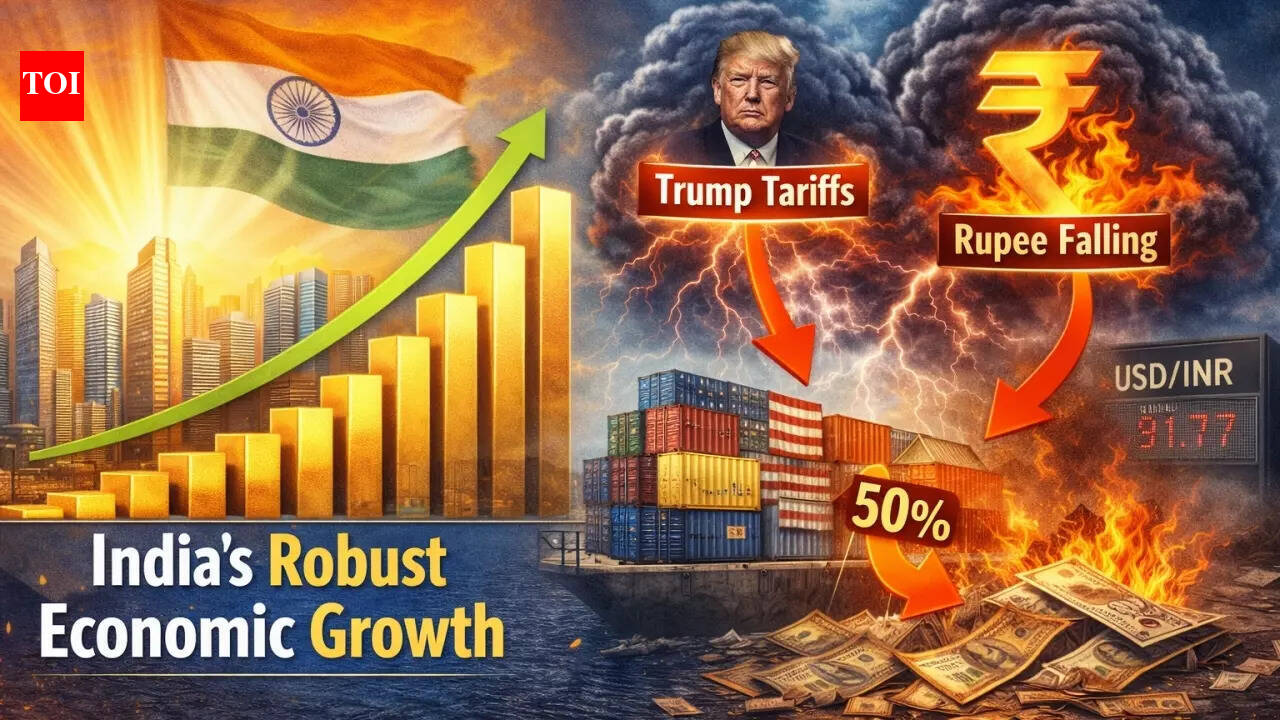
India is the world’s fastest growing economy – with an over 6-7% GDP growth rate – the world’s fifth largest economy is driving global growth. The International Monetary Fund (IMF) has acknowledged India as a key growth engine for the world. But amid increasing geopolitical and economic risks, especially US President Donald Trump’s policy uncertainty and tariff war, India’s growth story faces external headwinds.Even as India’s GDP growth has beaten forecasts so far this financial year – the big question is can it continue to grow well amid the global economic storm? Indian stock markets had a poor 2025, the rupee was the worst performing currency in 2025, and an India-US trade deal is yet to be finalized. Adding to injury, India faces 50% tariffs from the Trump administration, denting its exports. India’s growth is majorly domestic driven, yet global turbulence plays a key role in an increasingly interconnected world.
In this backdrop, Finance Minister Nirmala Sitharaman’s Union Budget 2026 assumes significance. What are the risks to India’s robust and resilient growth story, and what can Budget 2026 do to mitigate them? We ask economists:
What Are The Biggest Risks To India’s Growth Story?
Most economists surveyed by the Times of India Online point to two main risks: rupee depreciation, and Trump’s trade war and tariffs. The challenging external environment may weigh on India’s growth story, even though it is largely domestic demand driven.Economists believe that the rupee’s free fall may lead to imported inflation. They stress the need for the government to stick to the path of fiscal credibility. Economists warn of trade and tariff-led shocks unless an India-US trade deal is finalized. Madan Sabnavis, Chief Economist at Bank of Baroda doesn’t see any domestic headwinds. “The Indian economy is largely a domestic economy and here we do not see any major risk besides the usual assumption of a normal monsoon. The risk on the external side is still in the realm of tariffs as the affected industries are dependent on export markets of which the USA is a major player. This can be addressed by incentives on the credit side as well as direct support based on performance,” he tells TOI. Yuvika Singhal, Economist at QuantEco tells TOI, “The biggest macro risk India faces is from global uncertainty and rupee depreciation. In a global environment marked by heightened escalation of trade wars and economic policy uncertainty, it is essential to remain steady towards preserving domestic macro stability.”Ranen Banerjee, Partner, Government Sector Leader at PwC India agrees that the macroeconomic risks that India faces is on the exchange rate front as in the event the outflow of capital continues combined with headwinds to exports, the currency will be under pressure. “This could inflate the import bills and feed into inflation and put pressure on the current account balance. Since the monetary policy is outside the purview of the budget, the only way the budget can support the macro is through continued adherence to fiscal prudence by keeping the deficit in check, reducing the debt GDP ratio and keeping the quality of budgetary spend high,” he explains.Sujan Hajra, Chief Economist & Executive Director at Anand Rathi Group says that the biggest macro risk he sees in FY27 is the trade shock from higher US tariffs, given India’s export dependence on a few advanced economies.According to Rumki Majumdar, Economist at Deloitte India the biggest risks to India’s growth story are weak credit transmission despite RBI easing (MSME/household lending lag), inflation resurgence as demand accelerates (imported inflation from tariffs/INR depreciation), fiscal pressure from slower revenues amid external headwinds and reforms, and external shocks such as tariff hikes, FPI outflows, currency volatility; delayed India–US trade deal. For Dr DK Srivastava, Chief Policy Advisor, EY India buoyancy of tax collections is a factor that the government should keep in mind. “GST collections will go down and continue to remain low even in the next year. So there is a risk to fiscal consolidation that may emanate because of the fact that GST revisions took place and the rate effect has been immediate. The expectation was that the tax base will improve as consumption demand improves, but although it is improving, it is not enough to wipe out the GST reduction. This will have an impact on the budgetary, fiscal consolidation. So that is one risk to the other,” he tells TOI.Yet another factor he points to is: longer term risk related to household financial savings that have been falling relative to GDP over time now.Rishi Shah, Partner and Economic Advisory Services Leader at Grant Thornton Bharat flags the volatile geopolitical environment, fragmented global trade and increasingly fragile capital flows as risks for India. “While spending on AI and technology has supported growth across developed markets, this cycle seems narrow and possibly vulnerable. Any disruption could trigger risk-off behaviour, with capital flowing back to perceived safe havens, raising volatility in emerging-market currencies and asset prices,” he says.Sachchidanand Shukla – Group Chief Economist at Larsen & Toubro also cautions that resurgence of geopolitical risks and uncertainty over tariffs even though the IMF’s World Economic Outlook of January 2026 hints that the global economy has shaken off this shock are risks.
What Can Budget 2026 Do To Mitigate Macro Risks?
Crediting the government for sticking to the fiscal consolidation path, Yuvika Singhal says, “Post the initial COVID shock, India has displayed remarkable fiscal prudence in gradually scaling back the pandemic-era stimulus along with reinvigorating appetite for reforms. It is also imperative that the entrepreneurs’ animal spirits are rekindled to build real businesses. On the fiscal side, although the level of deficit/debt for India remains higher than that of its peers in advanced/emerging. economies, the resolve and the pace of fiscal consolidation has been commendable.““We believe the government should uphold the ethos of prudent fiscal consolidation and target a 1 percentage point reduction in its Gross Debt-to-GDP ratio from 56.1% in FY26 BE to 55.1% in FY27. Assuming Nominal GDP to grow by 10.0-10.5% in FY27, this could translate into an effective fiscal deficit range of 4.1-4.3% of GDP. In our opinion, the broader fiscal arithmetic would be formulated with an implied baseline target of 4.2% fiscal deficit/GDP ratio, which will provide two-way fiscal flexibility to the government. If growth momentum disappoints, then fiscal compression could go easy, with the deficit veering towards 4.3% of GDP by the end of FY27. On the other hand, if growth momentum surprises on the upside, the government could utilize the opportunity to deepen the counter-cyclical thrust by tightening the fiscal deficit to 4.1% of GDP by the end of FY27,” she adds.Sujan Hajra of Anand Rathi Group explains that since exports support over 40 million jobs, Budget 2026 needs to focus on targeted support for labour-intensive sectors such as textiles, leather and electronics to protect employment and competitiveness.“At the same time, the sharp increase in welfare spending by states is crowding out productive capex, with revenue expenditure dominating state budgets. The Budget can address this by linking central loans and additional borrowing space to capex utilization, while creating capex-linked incentives for states, ensuring fiscal support strengthens medium-term growth rather than consumption-led pressures,” he tells TOI. Rumki Majumdar of Deloitte India prescribes the following responses from Budget 2026 for the economy:
- Credit pipes: strengthen cashflow for MSMEs that are facing export stress, enforce payment timelines, and use targeted credit guarantees to help scale MSMEs.
- Supplyside disinflation: invest in logistics, power reliability, fixing legacy infrastructure issues, better service delivery in driving investment decisions. Already on the cards, customs reforms to ease bottlenecks
- Fiscal anchor: Keep deficit to the target, disinvestments, better asset utilization, communicate a medium-term debt-to-GDP glide path while preserving capex multipliers
- External diversification: accelerate FTA sequencing and utilization, and services mobility to offset single market risks.
Rishi Shah of Grant Thornton Bharat feels that Budget 2026 should prioritize resilience and sustainability. “Maintaining a strong pipeline of public capital expenditure remains critical to anchor growth and crowd in private investment when global capital flows turn cautious. At the same time, improving efficiency of expenditure and maintaining credible deficit trajectories will be key to preserving investor confidence. Finally, a sustained push on productivity, innovation and capability building—rather than incremental incentives—will be essential to ensure durable, domestically driven growth that can withstand external shocks,” he tells TOI.
