



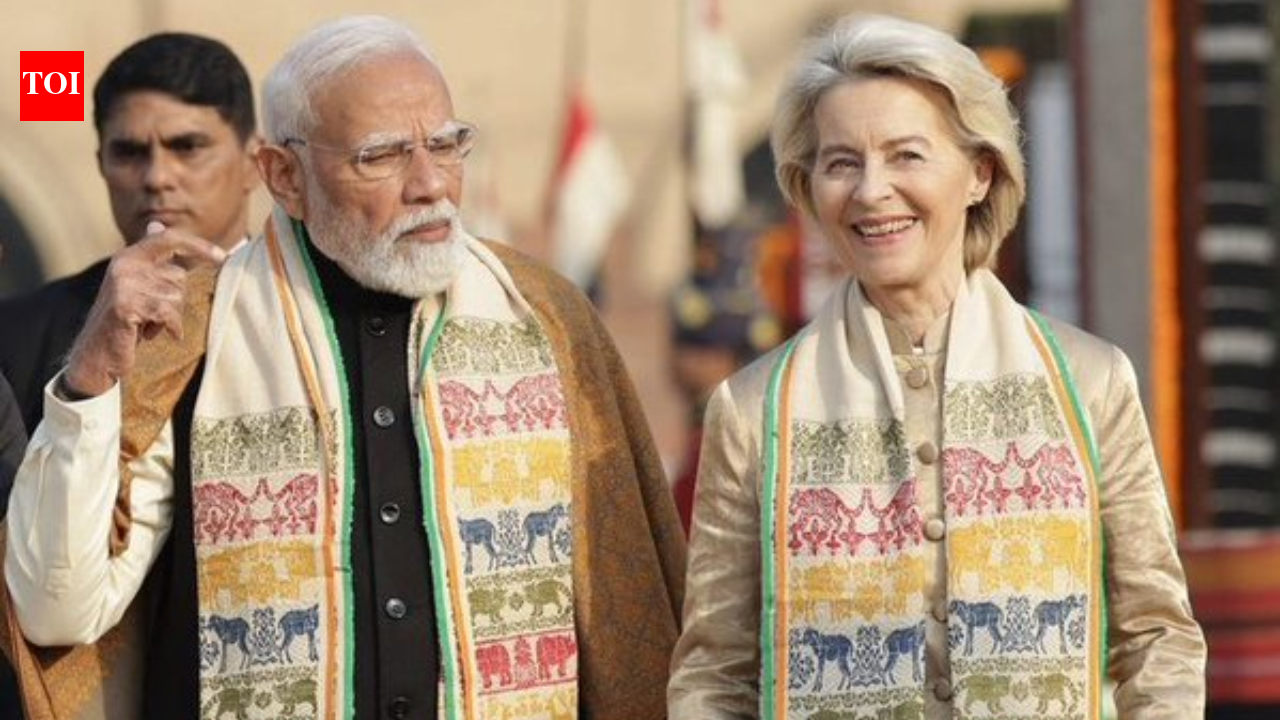
NEW DELHI: Prime Minister Narendra Modi and European Commission President Ursula von der Leyen drew wide attention on social media after they were seen twinning in a traditional Eri silk scarf during her visit to India. The silk scarf, also known as Eri silk or “Ahimsa silk,” featured elephant motifs and colour-blocked patterns. Ursula along with European Council president Antonio Costa came to India as chief guest for the Republic Day celebrations.India and the European Union also announced a landmark Free Trade Agreement (FTA) after nearly 18 years of negotiations.Sharing her thoughts on X, von der Leyen highlighted the significance of the moment and the broader partnership between the two sides. “Europe and India are making history today. We have concluded the mother of all deals. We have created a free trade zone of two billion people, with both sides set to benefit. This is only the beginning. We will grow our strategic relationship to be even stronger,” she wrote.The India-EU FTA, billed by the EU president as the “mother of all deals,” aims to deepen economic ties, reduce trade barriers and create one of the world’s largest free trade zones. The agreement was announced following summit-level talks between Prime Minister Modi and leaders of the 27-nation bloc.The cultural symbolism of the visit was also underlined ahead of Republic Day. Earlier, President Droupadi Murmu shared a video of the specially designed ‘At Home’ invitation sent to guests, which celebrated the living traditions of India’s North Eastern region. In a post on X, the President said the invitation was a tribute to the skilled artisans and craftspeople of the Ashtalakshmi states. “The invitation kit this year celebrates the living traditions of India’s North Eastern Region. This invitation is a tribute to the skilled artisans and craftspersons of the Ashtalakshmi states.”
What is Eri silk?
Eri silk, which featured prominently during the visit, holds deep cultural and ethical significance. Native to Assam, it is produced without killing the silkworm, earning it the name “Ahimsa silk.” Known for its warmth, durability and eco-friendly production, Eri silk is traditionally worn during festivals such as Magh Bihu and is closely linked to village life and women-led weaving practices.
