



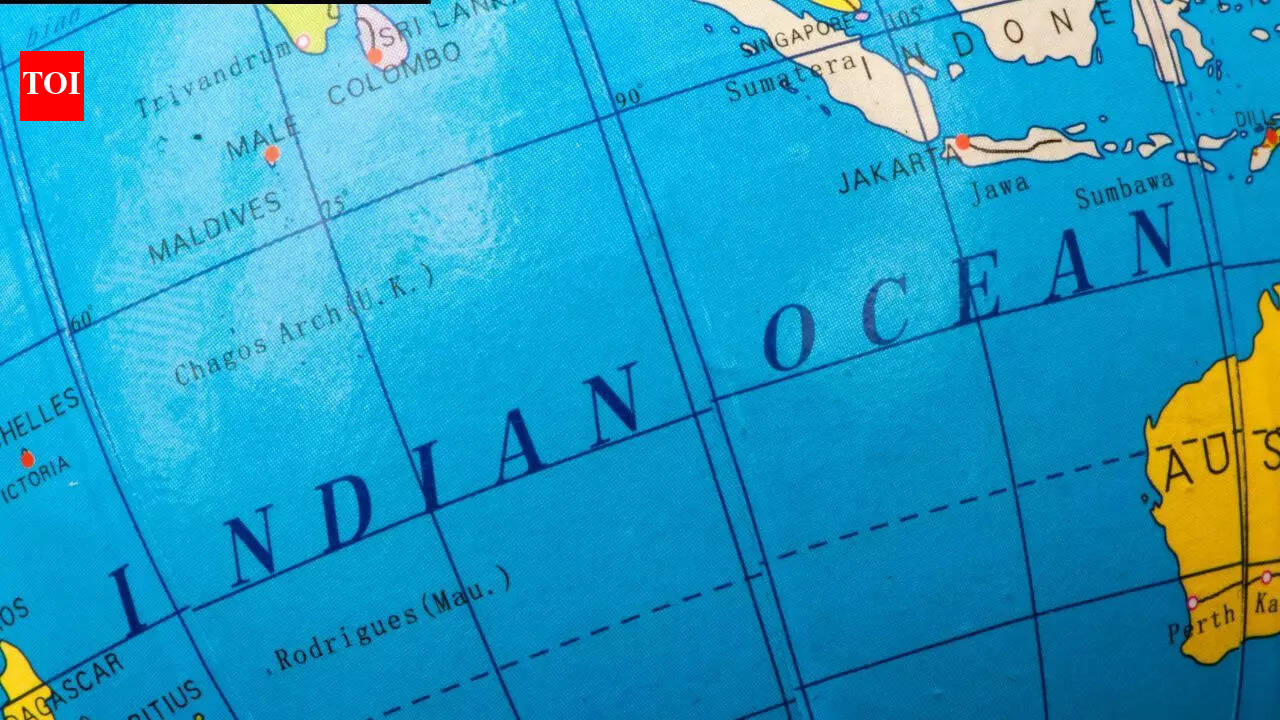
The Indian Ocean holds the lowest gravity anomaly on Earth, a vast and subtle depression in the planet’s gravitational field located south of Sri Lanka. Known as the Indian Ocean geoid low, it causes sea level in the region to sit more than 100 meters lower than the global average, even though the ocean surface appears calm. For decades, scientists have struggled to explain why this part of the planet behaves so differently. New research combining satellite measurements, seismic imaging and long term mantle modeling now suggests the answer lies deep inside Earth. Movements of tectonic plates, sinking slabs of ancient ocean crust and rising plumes of hot material appear to have shaped this hidden feature over tens of millions of years.
Earth’s deepest gravity mystery sits quietly beneath the Indian Ocean
The geoid represents an imaginary surface where Earth’s gravity is equal everywhere, closely matching mean sea level. Most variations are small. The Indian Ocean geoid low stands out because of its size and depth. Satellite data show it as the most negative long wavelength gravity anomaly on the planet. NASA observations indicate that the crust in this region sits hundreds of meters lower than expected if it were fully balanced by buoyancy. This means the mass deficit is not just at the surface but rooted deep in the mantle.How scientists first tried to explain the anomalyThe 2023 research, “How the Indian Ocean Geoid Low Was Formed,” takes a longer view. Instead of starting with the present, the models begin more than 100 million years ago. They follow the Indian plate as it moved north, closing the Tethys Ocean and colliding with Asia. As that ocean disappeared, slabs of old seafloor sank deep into the mantle. These slabs did not act quietly. Over time, they disturbed other deep structures far away, particularly beneath Africa. The link is indirect and not immediately obvious, but it matters.Heat rising where slabs sink onceAs the sinking slabs piled up, they nudged a large hot region near the base of the mantle known as the African Large Low Shear Velocity province. The disturbance helped trigger plumes of hot material that rose slowly beneath the Indian Ocean. These plumes did not erupt at the surface. Instead, they spread beneath the crust, reducing density in the upper mantle. The models suggest this process became more effective around 20 million years ago. The gravity low deepened not because slabs increased, but because heat moved closer to the surface.The reason the lowest gravity is not centered on a single source is unclearOne detail stands out. The deepest part of the geoid low does not sit directly above the hottest mantle material. Instead, it appears where several influences overlap. Warm regions in the upper mantle create a wide, shallow signal. Deeper heat stretches that signal outward. Distant plumes help confine it. The gravity low emerges from the balance of these effects rather than a single structure. When models remove one element, the match degrades. The feature becomes either too weak or too spread out.Why plate motion history mattersRecent research takes a different approach by running mantle convection models forward in time from the age of the dinosaurs to the present. These simulations include the northward drift of the Indian plate and the closure of the ancient Tethys Ocean. As India moved towards Asia, large volumes of oceanic crust were pushed deep into the mantle. These sinking slabs did not simply disappear. Instead, they disturbed deeper mantle structures beneath Africa, setting off a chain of events that unfolded far from where the slabs descended.The way deep plumes influence the gravity field is significantAccording to the new models, the Tethyan slabs altered the African Large Low Shear Velocity province, a massive hot region near the base of the mantle. This disturbance triggered plumes of hot material to rise beneath the Indian Ocean. As these plumes reached the upper mantle, they reduced density in the region, creating a broad mass deficit. This process intensified around 20 million years ago, when hot material spread beneath the lithosphere closer to India, deepening the geoid low without major changes in slab volume.Why the geoid low is not centered on a single sourceOne striking finding is that the lowest gravity does not sit directly above the deepest hot anomalies. Instead, the geoid low emerges from the combined influence of mantle structures around the region. Upper mantle temperature anomalies produce a wide, diffuse low, while deeper hot regions stretch the signal south and west. Only when these effects overlap does the observed shape appear. This phenomenon explains why models that include slabs alone or plumes alone fail to reproduce the real geoid.
