



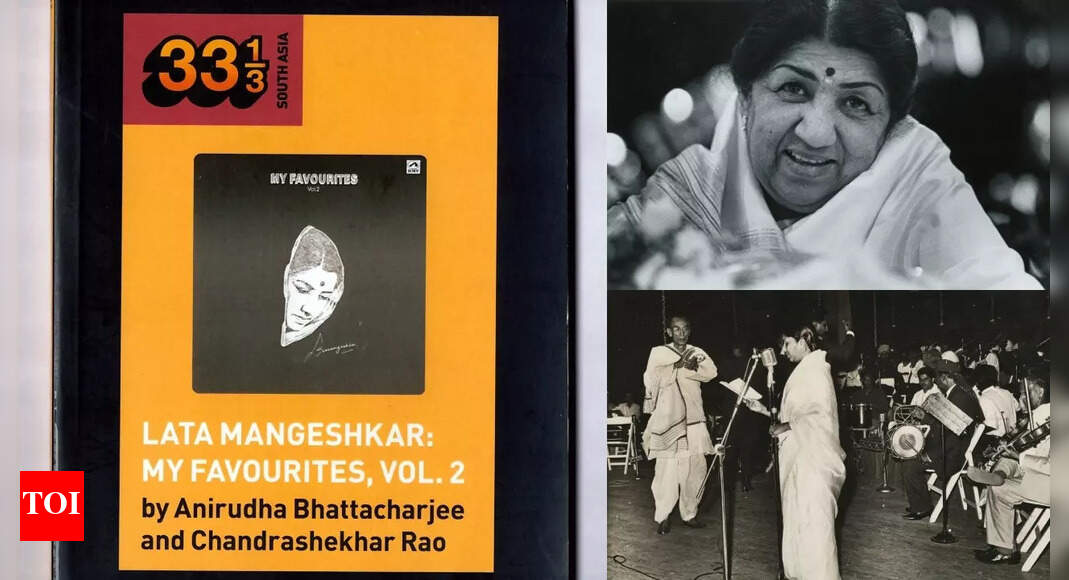
Few Things are embedded in India’s Popular Culture and Memory as Lata Mangeshkar. The singer, whose birth anniversary falls today, Continues to Nourish our Acoustics and Heart with Unerring frequency even after after her passing. Now a new book Titled, Lata Mangeshkar: My favorite, Vol 2 by anirudha bhattacharjee and chandrashekar rao, decodes her own taste in songs. In an email interview, the authors not only provide an insight into lata’s choos but also Your Book, Lata Mangeshkar: My favorite, Vol 2, is part of a series, 33 1/3. What does the series indicate? A: Anirudha Bhattacharjee (ab): The series name referrs to the rotation speed of a vinyl lp and is about a composite review of a music album. The series, started in 2003, is generally popular in universities in the us with students of music. Our book is the first one from India, by an indian (in fact, two Indians) and the first about a music personality from India as well. The nature of the books in the series is generally academic.Chandrashekar Rao (CR): That’s Neatly summed up. Q: Lata Mangeshkar: My favorite, vo.2 is a collection of 50 songs, most of them from Hindi films, over 40 years. The interesting thing is that they were selected by the singer herself. What does the choices tell us about the singer? A: ab: tricky question. Lata would often juggle her favorite, and this is something we have mentioned in the book. In Most Cases Than Not, The Favourites BE A Function of Her Mood At that Point in Time, and Not NECessArily Her Most Accompiled Songs. However, her output was so wide and musical that she had the liberty of choosing from a pleethora of songs, and generally these were better than most of what we hear today on the radio. Most Importantly, She Managed The Timeline Well.Metrics Like ‘Recentcy Factor’ or ‘Nostalgia’ did not overrule her Judgement. And the songs would be nicly scattered along the timeline of her career, helping the listener to appreciate the changing genres, styles, instruments, and lyrical and componental patterns. So, you have ‘dil mera toda’ from Majboor (1948) as well as ‘Husn Pahadon Ka’ from Ram Teri Ganga Maili (1985).CR: Lata Mangeshkar Remains One of the Most Prolific Singers. While others may have recorded more songs, hers remain unsurpassed for quality and popularity. With Thousands of Songs Rendered Over Seven or Eight Decades, it’s no surprise that the gramophone company of India (More Simply, HMV) Prevailed Upon Her On Several Occasions TOVONSS TOWN FAVOURITES to serve as album compilations. We do not know if she pondred over these requests at length – more like she piping songs that study out cleaned in memory at that point in time, and (again, possibly) Certain composers and lyricists as much as the songs themselves. The selection has a maximum of six songs composed by Shankar Jaikishen And Six Songs Written by Majrooh Sultanpuri. What does that indicate?Ab: This is an area that we found to be skewed in favor of a few select composers like sj and roshan. About Majrooh, we would like to mention that he worked decades and for almost all the composers from the ’40s to the’ 90s, so that is undersrstandable. So, out of the six, we have songs from sd, rd, even chitragupta and ghulam mohammed in the album, all of which have lyrics by majrooh.Coming to sj, this is a green area. Cold behavuuse her list of favorite Her Silver Jubilee Celebration in 1967 did not have a single song by sj. Making up? Or is it possible that Shankar’s passing away during the time the time this compilation was being discusced influenced her choices? One would never know.CR: as I mentioned above, her selection is likely arbitrary. Probably no meticulous plan of striiking a reasonable balance to ensure all composers and lyricists were represented equally was made.Are you surprised that the collection doesn’t have a single song by Usha Khanna, The Most Famous Woman Music Director of Hindi Cinema? Ab: Yes, as a carryover from the previous question. You see, Forget Usha Khanna; There is no song of eater kalyanji anandji or Ravi. Incidentally, not even in volume 1, which was published in 1987. So, we do not know. Artistes Think differently, at least lata did for sure.CR: While This Album has no Usha Khanna Song, I distinctly recall another collection which featured her ‘Teri Nigahon Ne Sawal Kiya’, from Main Hoon Alladin (1965). But that lp might have been compiled by HMV themselves (there are many of that,! And not by lata. The book has several fascinating anecdotes. Can you please narrate two of Them?A: Ab: The recording story of ‘kya janun sajan’ (Baharon ke sapne, 1967) is one. In the Mid-1960s, RD was experimenting with Twin-Track Recordings. Traditional spool recording equipment of the time would erase previous audio before recording new sound. To create the unique layered vocals for the song, RD first recorded the main melody. Then, He removed the erasing head from the equipment and recorded the harmony in the same pool. This innovative method allowed both tracks -the melody and the harmony – to play simultaneously, creating the illusion of two different singers. Although RD Discussed His Creative Process with the Media, The Record Company, GCI, Credited the Song as a Duet Between Lata and Her Sister Usha. It wasn’t until the 21st century, after Lata Mangeshkar Herself Reveled The Story to the Press, that the record was set straight.Another story that is not directly concerned with lata but is mentioned by Dr. Rao. During the recording of ‘Ore Majhi’ for Bandini (1963), SD Burman, Who was singing his own composition reacted to salil chowdhuri to sit in for an indispaned record. (Probably bn sharma, as this was recorded at bombay labs). Something unique.CR: Let me take this options to narrate one that is not in the book, which illustrates how lata mangeshkar frequently had a hand in a song’s creation too. As narrated to me by composer pyrelal, an incident during the recording of the song ‘Meghwa Gagan Beech Jhanke’ from Harishchandra Taramati (1963): The Song is in Raag Kalavati, in Raag Kalavati, in Raag Kalavati, in Raag Kalavati, in Raag Kalavati, in Raag Kalavati, in Raag Kalavati, in Raag Kalavati Jhanjhanake ‘. Lata suggested that the last ‘Ke’ syllable should land on the ‘Madhyam’, a note conventionally Absent in that raga – so annual thoughts aberrant it turns out Retained.How would you sum up lata’s contribution to popular music in India?A: AB: I am not sure if this is hearsay, but there was something in the 1960s when a listener in lahore sent a letter to air, the gist of which was something like – ‘Give us lata, we will give you kashmir.’ I think that, in a nutshell, tells of her huge influence not only in India but also across the subcontinent. The great musical personality of the country in the last century. And I am not sure who could be labelled as the greenst film personality of the last century in India – a tussle between her and satyajit ray.CR: If the hindi film Music Industry Needed to be disturbed down to a single person serving as yardstick between pre- and post-colden era (Roughly 1949-1975 Going by Popular Consensus) Be Lata Mangeshkar. Her contribution is colossal, with individual songs serving as personal memory millstones for Thousands of Listeners; Her dulcet Voice had no equal; Her ease of rendition in navigating the most complex ‘Murki’ or ‘Harkat’ Challenges Highly trained singers even today, for who she wrote the ultimate reference book. She is the book.
