



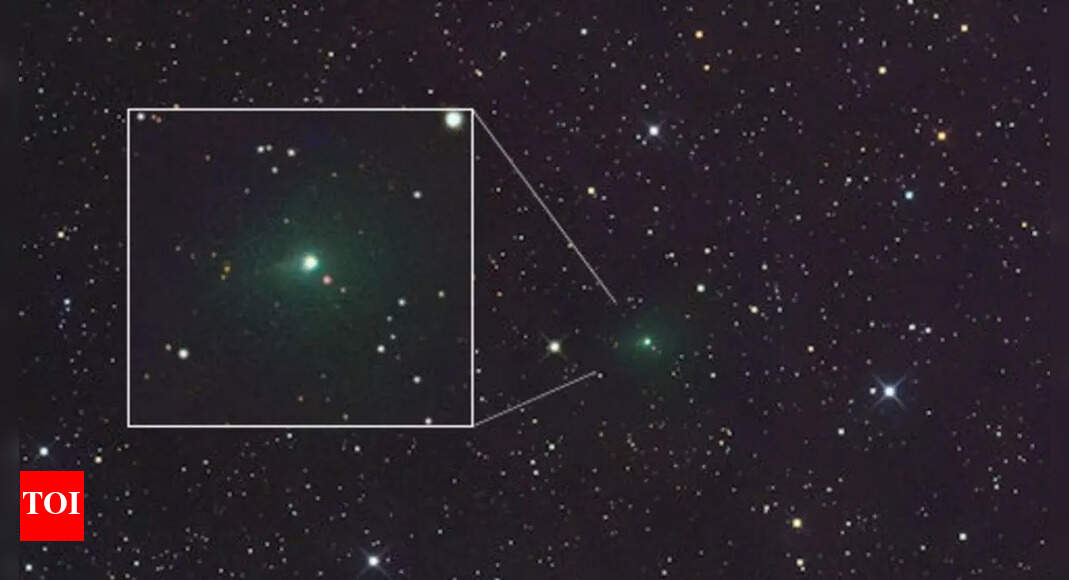

Comet 3I/ATLAS has fascinated astronomers and space enthusiasts worldwide as it makes its rare journey through our solar system. Recognized as the third known interstellar object, 3I/ATLAS originates from beyond our Sun, offering a unique glimpse of a visitor from another star system. Unlike typical comets that orbit the Sun, it follows a hyperbolic trajectory, passing through the solar system only once. Its closest approach to the Sun occurred on 29 October 2025, at about 1.36 astronomical units, while its path ensures it will never return. Observing 3I/ATLAS provides scientists with invaluable insights into the composition and behavior of interstellar objects, enriching our understanding of the universe beyond our own solar system.
3I/ATLAS: A rare interstellar visitor offering insights beyond our solar system
NASA has confirmed that 3I/ATLAS is an interstellar object, meaning it did not form within our solar system. Unlike comets that orbit the Sun, 3I/ATLAS follows a hyperbolic trajectory, passing through the solar system only once before continuing its voyage through interstellar space. This rare visitor provides scientists with a unique opportunity to study pristine material from beyond our solar neighborhood, offering clues about galactic formation and evolution. Its closest approach to the Sun occurred on 29 October 2025, at a distance of approximately 1.36 astronomical units (over 200 million kilometers).The comet’s interstellar origin makes it a subject of immense scientific interest. Observing 3I/ATLAS provides valuable insights into the composition and behavior of objects formed around other stars, enriching our understanding of the broader universe.
When and where to see comet 3I/ATLAS
3I/ATLAS is not visible to the naked eye. Only observers with telescopes featuring an aperture of at least eight inches are likely to detect the comet. Astronomers anticipate the best viewing opportunities from mid to late November 2025, when it becomes visible in the eastern predawn sky.As reported by IFL Science, during this period, the European Space Agency’s (ESA) Jupiter Icy Moons Explorer (JUICE) mission is expected to observe the comet with its advanced instruments. Between 2 and 25 November, JUICE will track 3I/ATLAS as it remains active, surrounded by a glowing coma and an elongated tail. Observation data from this mission is expected to be released in February 2026.For space enthusiasts wishing to follow the comet’s journey in real time, NASA’s interactive tool, Eyes on the Solar System, offers a detailed simulation of 3I/ATLAS’ path.
3I/ATLAS’ journey through the solar system: From Mars flyby to Earth’s safe distance
The comet recently passed close to Mars between October 2-3, at a distance of roughly 29 million kilometres. ESA confirmed that the ExoMars Trace Gas Orbiter (TGO) and Mars Express captured images of 3I/ATLAS during this period, although the comet appeared as a faint, blurred white spot against a backdrop of streaked stars.Following its solar approach, 3I/ATLAS will pass closest to Earth on December 19, 2025, maintaining a safe distance of 1.8 astronomical units (around 270 million kilometers) as reported by Space.com. Scientists stress that there is no threat to Earth from this interstellar visitor.
3I/ATLAS: Origins and characteristics
3I/ATLAS is believed to have formed in a distant star system before being ejected into interstellar space. It has drifted through the galaxy for millions or even billions of years before reaching our solar system, approaching from the general direction of the constellation Sagittarius, home to the Milky Way’s central region.Its hyperbolic trajectory confirms that it is not gravitationally bound to the Sun, distinguishing it from typical comets or asteroids. As a result, 3I/ATLAS will continue on its one-time passage, never to return.
How 3I/ATLAS compares to other interstellar objects
3I/ATLAS is the third known interstellar object. The first, ‘Oumuamua, was discovered in 2017, followed by 2I/Borisov in 2019. Unlike asteroids, 3I/ATLAS is classified as a comet because it exhibits activity, an icy nucleus surrounded by a bright coma of gas and dust.Astronomers estimate that the comet’s nucleus has a diameter between 440 meters and 5.6 kilometers, based on observations from the Hubble Space Telescope. Its speed is extraordinary, traveling at approximately 221,000 kilometers per hour (61 kilometers per second) upon discovery, increasing as it neared the Sun.
Tips for observing interstellar comets
While its interstellar origin is remarkable, there is no risk posed to Earth. The comet’s trajectory ensures it will not approach closer than 1.8 astronomical units. Observing it offers a unique opportunity to witness the passage of a visitor from another world without any danger to our planet.To maximize your chances of seeing 3I/ATLAS:
- Use a telescope with at least an eight-inch aperture.
- Observe during the eastern predawn hours in mid to late November.
- Track its movement using NASA’s Eyes on the Solar System tool or telescope-guided apps.
- Patience is key, as the comet appears as a faint, moving object against the backdrop of stars.
While 3I/ATLAS will eventually fade from our skies, its brief visit reminds us of the vastness of the cosmos and the interstellar journeys that unfold beyond our solar system. For astronomers and stargazers alike, it is a once-in-a-lifetime spectacle.Also Read | 3I/ATLAS may be the oldest comet ever seen in 7 billion years, carrying secrets from before the solar system began
