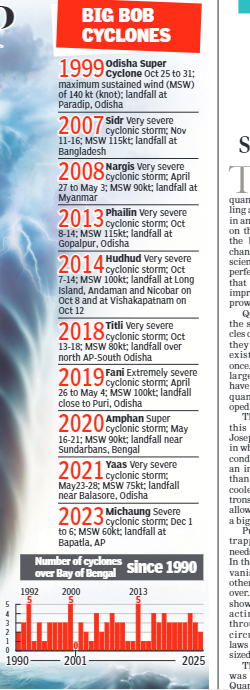

It’s that time of the year when India’s east coast braces for cyclones that pose a threat to lives and livelihoods. But are cyclones all that bad? A new study shows these extreme weather systems can have an environmental benefit: carbon sequestration.The Indian Ocean absorbs about 190 million tonnes of carbon every year. The study by National Institute of Oceanography (NIO), Academy of Scientific and Innovative Research (AcSIR) and India National Center for Ocean Information Services (INCOIS) on the Bay of Bengal shows tropical cyclones boost this absorption, and the northern Indian Ocean plays a bigger role in global carbon budget than previously thought.
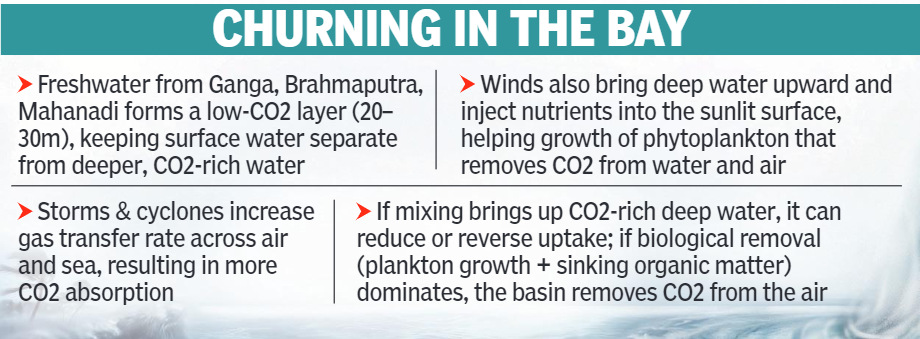
The study found tropical cyclones help the sea take in more carbon-dioxide (CO2) by stirring the waters. They alter the movement of CO2 between air and sea, and stimulate growth of phytoplankton that absorbs CO2 photosynthesis. “Tropical cyclones enhance the CO2 sink. Climate change is expected to increase the frequency and intensity of tropical cyclones,” said VVSS Sarma, corresponding author and chief scientist at National Institute of Oceanography (NIO).Researchers analyzed two cyclones – Michaung (2023) and Hudhud (2014) and found cyclones can increase or decrease CO2 uptake depending on salinity and layers of water. Stratification occurs when lighter freshwater forms a layer over denser, saltier water. The Bay of Bengal gets heavy freshwater from rivers Ganga, Brahmaputra, and Mahanadi, creating a strongly stratified upper layer in the north and weaker layer in the south.Strong stratification allows cyclone winds to increase the ‘piston velocity’, the rate at which gases transfer from air to sea, enhancing CO2 uptake. In the south, weaker stratification allows mixing to bring CO2-rich waters from below to the surface, reducing the net sink.In the Bay of Bengal, freshwater from major rivers has relatively low CO2 compared to the atmosphere. This water forms a 20m–30m layer and keeps absorbing atmospheric CO2. “During cyclones, strong winds enhance this flux. In the Arabian Sea, except for the Narmada, rivers are small and mixing is stronger. Water below 50m contains high CO2, and cyclones bring this to the surface, sometimes making the sea act as a source rather than a sink,” Sarma said.During cyclone Michaung, the Bay’s CO2 flux from the atmosphere to the ocean decreased by about 1.6 teragrams of carbon (TgC) or 1.6 million tonnes but at the same time, nutrient injection from mixing increased phytoplankton growth, which biologically removed about 1.1TgC. The study reports that net primary production (NPP), which is the carbon fixed by phytoplankton through photosynthesis, rose from 4.9 TgC per day before the cyclone to 5.2 TgC per day during its passage. The researchers concluded that the net change in CO2 flux during Michaung was insignificant.Cyclone Hudhud had stronger winds and deeper mixing. While the physical CO2 flux dropped by 0.3 TgC, biological CO2 removal rose by 1.7 TgC, showing that biological processes dominated CO2 uptake six times more than physical exchange at the surface.The study used buoy data, satellite observations, and computer models, measuring sea surface temperature, salinity, partial pressure of CO2, and chlorophyll-a before, during, and after the cyclones. Sarma said the cyclone effect is temporary but significant as only about 10% of the absorbed carbon sinks below 1,000m and stays locked for centuries, and the rest returns to the atmosphere within years or decades. “With 10 cyclones or depressions a year, that’s about 30 weeks of impact,” he said.Greater CO2 absorption, however, comes at a cost. More dissolved CO2 lowers pH, leading to ocean acidification. “By the end of this century, pH could drop by about 0.2 units. Some phytoplankton may benefit, others may die, changing biodiversity. Since planktons are the base of the food chain, this will affect marine species,” Sarma said.A 2014 NIO study found that the Bay of Bengal is more acidic than the Arabian Sea, Atlantic Ocean or the Pacific Ocean. The pH in the Bay’s upper 100m is up to 0.39 units lower than in the Arabian Sea, mainly due to freshwater inflows and weaker mixing. Acidified water occurs much shallower in the Bay (350–500 m) than in the Arabian Sea (1,000 m), putting plankton and shell-forming organisms at greater risk.Pravakar Mishra, a former scientist at the National Center for Coastal Research, said coastal waters are getting acidic three times faster than open oceans, because of pollutants like sulfates and nitrates. Oceans absorb about 2 petagrams (two billion tonnes) of carbon annually, of which the tropical Indian Ocean accounts for about 0.2 petagrams (10%). While small compared to larger basins like the Atlantic, this absorption is vital for India’s carbon balance.