



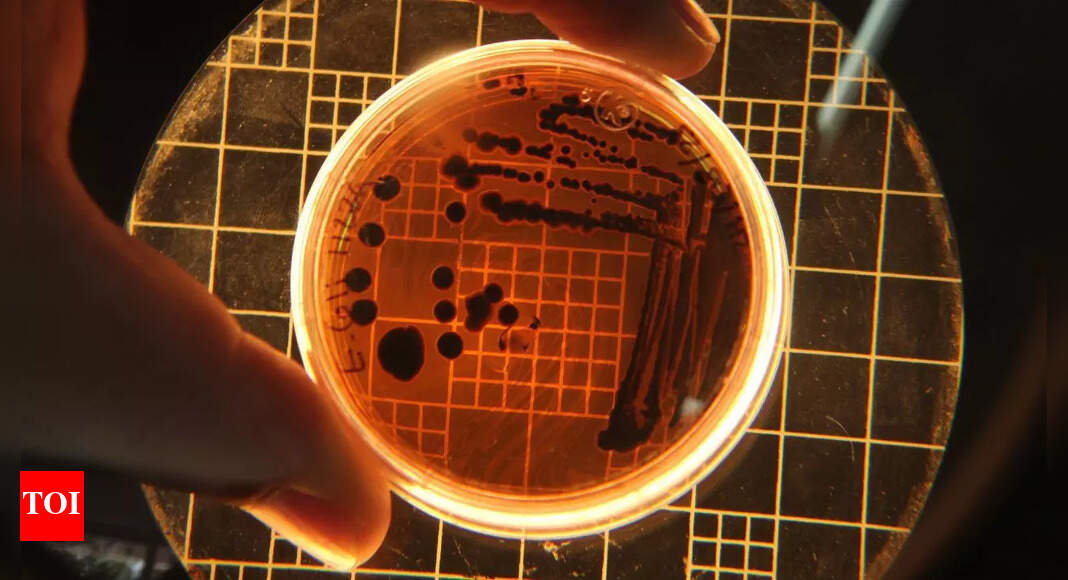
Beneath the familiar crust we walk on lies a vast, unseen world teeming with microscopic life. For decades, scientists assumed the deep Earth was too hot, dark, and nutrient-poor to sustain anything alive. Yet new discoveries are forcing us to rethink the boundaries of biology. These strange microbes are thriving kilometers underground and may even be finding their way to the surface.A peer-reviewed study published in Frontiers in Microbiology (2021) revealed that dense microbial communities exist in basalt fractures several kilometers beneath the ocean floor, capable of surviving entirely on chemical reactions between rock and water. This discovery challenges the idea that life depends solely on sunlight and suggests a hidden biosphere influencing surface ecosystems in ways we are only beginning to understand.
What are deep-earth microbes and how do they survive
The term “deep-Earth microbes” refers to microscopic organisms living in rock pores, mineral veins and aquifers far below the surface. These microbes exist in conditions once thought impossible for life: extreme heat, crushing pressure and total darkness. Instead of relying on photosynthesis, they obtain energy through a process called chemosynthesis. By reacting minerals such as iron and sulfur with water, they generate the energy needed to grow and reproduce.Researchers drilling into deep basalt formations off the coast of Japan and South Africa have discovered entire ecosystems sustained this way. These microbes have slow metabolisms, sometimes dividing only once in a century, yet they are remarkably resilient. Some even repair their DNA after long periods of dormancy, indicating an evolutionary strategy for surviving over geological timescales.
How deep-Earth microbes could be reaching the surface
Scientists now believe that these deep-Earth microbes are not confined to their underground world. Over millions of years, groundwater movement, volcanic activity and tectonic shifts can carry them upward. When cracks form in the crust, they act as microbial highways, allowing small populations to travel through mineral fractures until they reach more hospitable environments.Once near the surface, these microbes might colonize soil, rock or even water bodies. Studies of groundwater near fault zones show traces of deep biosphere DNA, suggesting that migration is an ongoing process. Some of these organisms may adapt to new environments, becoming part of the surface microbiome that influences everything from soil fertility to carbon cycling.
Why deep-Earth microbes matter for climate and ecosystems
The discovery of deep-Earth microbes has far-reaching implications for how we understand the planet’s ecosystems. If these organisms are interacting with the surface biosphere, they may contribute to global processes such as carbon storage and greenhouse gas regulation. Chemosynthetic microbes can convert carbon dioxide into organic matter, effectively locking away carbon that would otherwise contribute to warming.In addition, these microbes may recycle nutrients deep underground, creating a slow but steady flow of elements such as nitrogen and phosphorus toward the surface. Their activity could help sustain surface life during environmental changes, acting as a hidden stabilizing force within Earth’s ecosystems. This idea reframes our understanding of how interconnected life truly is, from the ocean floor to the mountain peak.
What deep-Earth microbes can tell us about the origins of life
The existence of thriving microbial ecosystems deep underground also sheds light on one of science’s oldest questions: how life began. Many researchers now believe that early Earth may have hosted its first living cells within mineral-rich hydrothermal vents or underground aquifers rather than on the surface. The same chemical reactions that power today’s deep-Earth microbes could have provided the first energy sources for life billions of years ago.This perspective also strengthens the possibility of finding life beyond Earth. Planets and moons such as Mars or Europa have subsurface environments with liquid water and minerals, conditions similar to those supporting microbes on Earth. If life can flourish in our own planet’s deep crust, it might do so elsewhere too, hidden beneath the surface where it is shielded from radiation and extreme cold.
The unanswered questions about deep-Earth microbes
Despite growing evidence, scientists still have much to learn about how deep-Earth microbes interact with surface life. Do they truly colonize new habitats or merely influence them indirectly through chemical changes? How fast can they migrate, and what triggers their movement upward? Answering these questions will require advanced drilling projects, DNA sequencing, and isotopic tracing to track microbial pathways across different depths.Another mystery is how extensive the deep biosphere really is. Estimates suggest it could hold more than half of Earth’s total microbial biomass, yet direct sampling remains limited. As technology improves, researchers hope to map this vast hidden network and understand its role in the planet’s long-term evolution.The discovery of deep-Earth microbes has revolutionized our understanding of where life can exist and how it connects across layers of our planet. These invisible organisms form a silent bridge between Earth’s interior and surface, influencing everything from climate regulation to the potential origins of life. As we continue to explore this underground world, one thing becomes clear: the story of life on Earth did not begin or end at the surface. It has always been deeper, older and far more mysterious than we ever imagined.Also read| Eugene Shoemaker: The only human buried on the Moon, and why NASA honored him
