



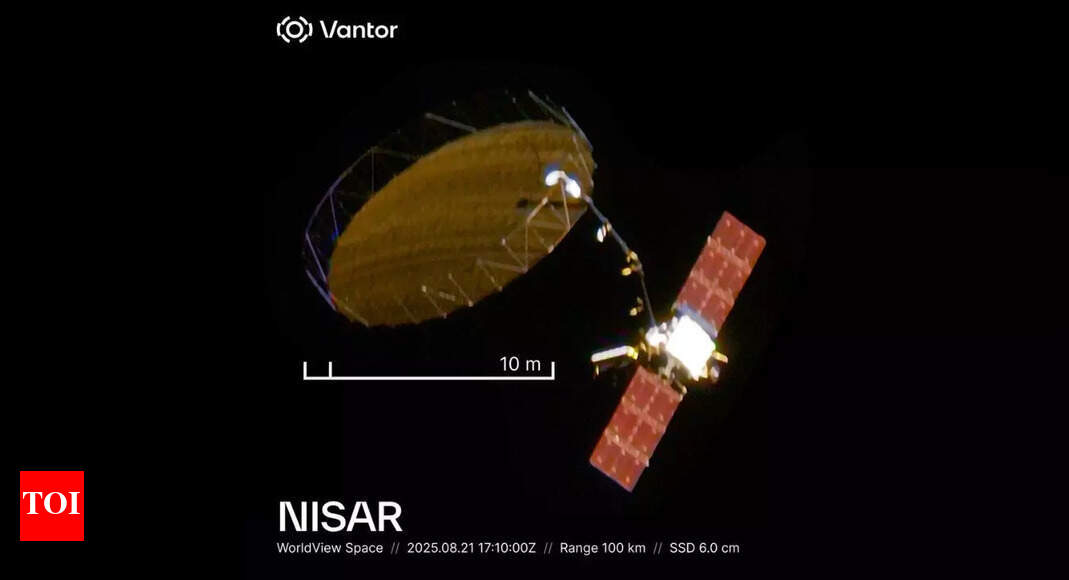
A recent post on X by VantorTech has captured global attention after revealing an incredibly detailed image of the NASA-ISRO NISAR satellite. The post, shared on October 16, 2025, featured the satellite’s massive radar antenna deployed in space, accompanied by a caption that described it as “the most powerful radar satellite ever built.“The image, taken with centimetre-level clarity, provided a glimpse of how space technology is now being used to monitor not just Earth but also spacecraft themselves. The post quickly went viral, sparking discussions across science and tech communities about how spatial intelligence and non-Earth imaging are reshaping the way we understand our planet and its orbiting assets.
NISAR satellite unveiled in high-resolution image
The viral post by VantorTech showcased the NASA-ISRO Synthetic Aperture Radar (NISAR) satellite in full operational form, following the successful deployment of its massive circular radar antenna in August 2025. Measuring 12 meters in diameter, the antenna is the largest radar reflector ever placed in orbit. The image revealed the fine structure of the mesh reflector with such precision that experts could verify its deployment geometry, surface tension, and alignment—details that normal telemetry data cannot fully. confirm.VantorTech described the photo as “full bloom on the most powerful radar satellite ever built,” highlighting the advanced imaging capability of its WorldView Space system. The company explained that this non-Earth imaging tool allows for real-time assessment of space assets, ensuring that mission teams have immediate clarity on spacecraft status and orientation. For decision-makers managing critical missions, such insights eliminate the need to wait for ground-based confirmation.
What makes the NASA-ISRO NISAR satellite so unique
NISAR stands for NASA-ISRO Synthetic Aperture Radar, a collaborative mission between the United States’ National Aeronautics and Space Administration (NASA) and India’s Indian Space Research Organization (ISRO). The project combines two radar systems—L-band from NASA and S-band from ISRO—making it the first satellite mission in history to use dual-frequency radar for Earth observation.A study published by NASA’s Jet Propulsion Laboratory stated that the satellite’s purpose is to monitor Earth’s changing ecosystems, track ice-sheet movements, and study natural hazards like earthquakes and landslides. It will also provide vital data on groundwater levels and sea-level rise.Once operational, NISAR will orbit Earth every 12 days, mapping the planet’s surface with an accuracy of up to one centimetre. Over its planned three-year mission, it will capture data across both ascending and descending passes, meaning most areas of the Earth will be observed every six days. These continuous observations will help scientists track even the smallest changes in the planet’s surface, from shifting glaciers to deforestation patterns.
How VantorTech’s WorldView system changes space monitoring
VantorTech’s image of NISAR was not captured by a typical telescope. Instead, it was taken through the company’s advanced WorldView Space non-Earth imaging capability—a technology built to provide “trusted intelligence” about spacecraft in orbit. In its post, the company explained that this technology allows for centimetre-level inspection of satellites, including details like the tension of deployed structures and the precise orientation of antennas.This kind of spatial monitoring offers something traditional telemetry cannot: visual confirmation. While telemetry provides numerical data on the satellite’s status, images give engineers direct visual proof that deployment mechanisms, structural alignments, and component orientations are correct. VantorTech’s imaging system also collects motion and velocity data to complement this analysis.In the words of the company’s post, “decision makers don’t have days to wait for answers.” By delivering near-real-time imagery of high-value assets in orbit, VantorTech is helping both government and commercial agencies ensure their spacecraft are performing as expected. This kind of monitoring is becoming crucial as the number of satellites in orbit continues to grow rapidly.
NISAR’s impact on global science and Earth observation
The NISAR mission represents a major leap for global Earth science. Its dual-band radar will provide a continuous, uniform view of the planet, helping scientists understand how Earth’s surface is changing. By measuring movements as small as a centimetre, the mission will shed light on environmental issues like ice loss in polar regions, soil moisture depletion, and forest degradation.The data will also help authorities prepare for natural disasters. For example, by monitoring ground movement before earthquakes or tracking flood plains, scientists can offer early warnings and improve disaster response. In agricultural regions, NISAR’s radar can detect shifts in soil and water content, helping to guide sustainable farming practices.Beyond environmental monitoring, NISAR’s success also highlights the growing strength of international cooperation in space technology. The partnership between NASA and ISRO demonstrates how pooling resources and expertise can lead to innovative outcomes that benefit the global community. The mission’s data will be freely available to researchers worldwide, encouraging collaboration across nations and disciplines.Meanwhile, companies like VantorTech are helping to extend this ecosystem by offering a new dimension of “spatial intelligence”—the ability to monitor space assets visually, not just through data. streams. This dual approach of observing both Earth and the instruments observing Earth marks a new chapter in satellite technology.The viral It combined the precision of scientific engineering with the immediacy of digital communication, allowing the public to witness a remarkable technological milestone. As NASA and ISRO prepare NISAR to begin its mission of mapping Earth’s changing surface, and as companies like VantorTech continue to refine non-Earth imaging, the space industry moves closer to an era of complete visibility—from orbit to ground. In a world that increasingly depends on satellites, clarity from above has never mattered more.Also Read | The hidden planet beyond Pluto: Is Planet Y real
