



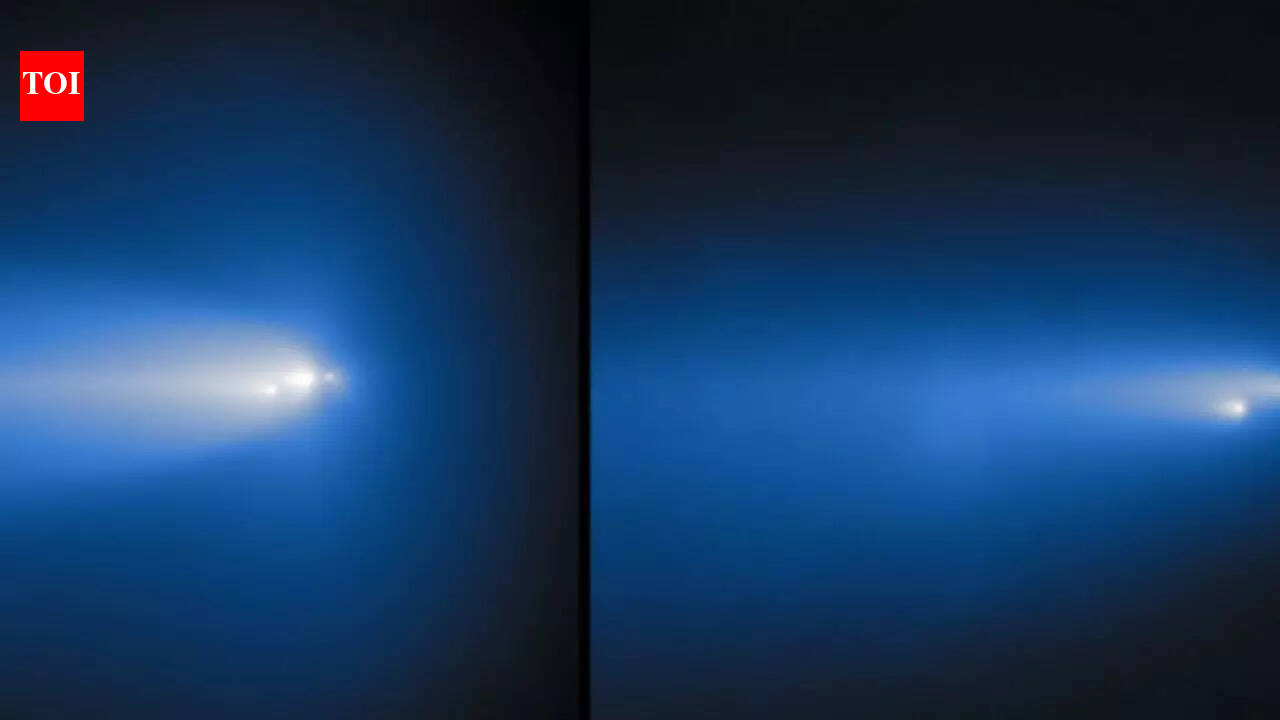
Comet C/2025 K1 ATLAS, a relatively new visitor from the outer solar system, has broken apart after swooping close to the Sun in October 2025. Stunning images captured by the Gemini North telescope in Hawaii show glowing fragments tumbling through space, like shards of icy glass, which observers say is a rare sight. These long-period comets are loosely bound collections of ice and dust, so they’re fragile. They might look solid in pictures, but they can crumble with just a little push from the Sun’s gravity or the solar wind.
Comet C/2025 K1 ATLAS captured breaking apart in new telescope images revealed
As reported in NOIRLabthe new image released on 29 January, falling apart in the pictures obtained: with one set from November 11, 2025, shows a glowing white streak with hints of blue, streaking across the dark sky. By December 6, the comet had further fragmented. Experts say these pictures are rare because most comets aren’t observed in such detail when they break up. High up on Mauna Kea, the Gemini North telescope reportedly captured the comet in all its messy glory. It’s a big telescope with 8.1 meters across at the International Gemini Observatory. C/2025 K1 (ATLAS) made its closest approach on October 8. The Sun’s gravity and the solar wind apparently worked together to rip the comet into pieces. Astronomers saw at least three chunks, maybe a fourth with distances of up to 2,000 kilometers reportedly separated some pieces.
Gianluca Masi and Asiago Observatory catch the comet splitting
Gianluca Masi in Italy caught it too, using a smaller telescope; he apparently saw three or four fragments. The Asiago Observatory also spotted two main pieces separated by roughly 1,200 miles. It’s like watching cosmic fireworks, but frozen in time. C/2025 K1 (ATLAS) isn’t from around here. It was discovered in May 2025 by the Asteroid Terrestrial-impact Last Alert System. Billions of comets might float out there, dormant for eons, until a gravitational nudge sends one falling toward the Sun.
