



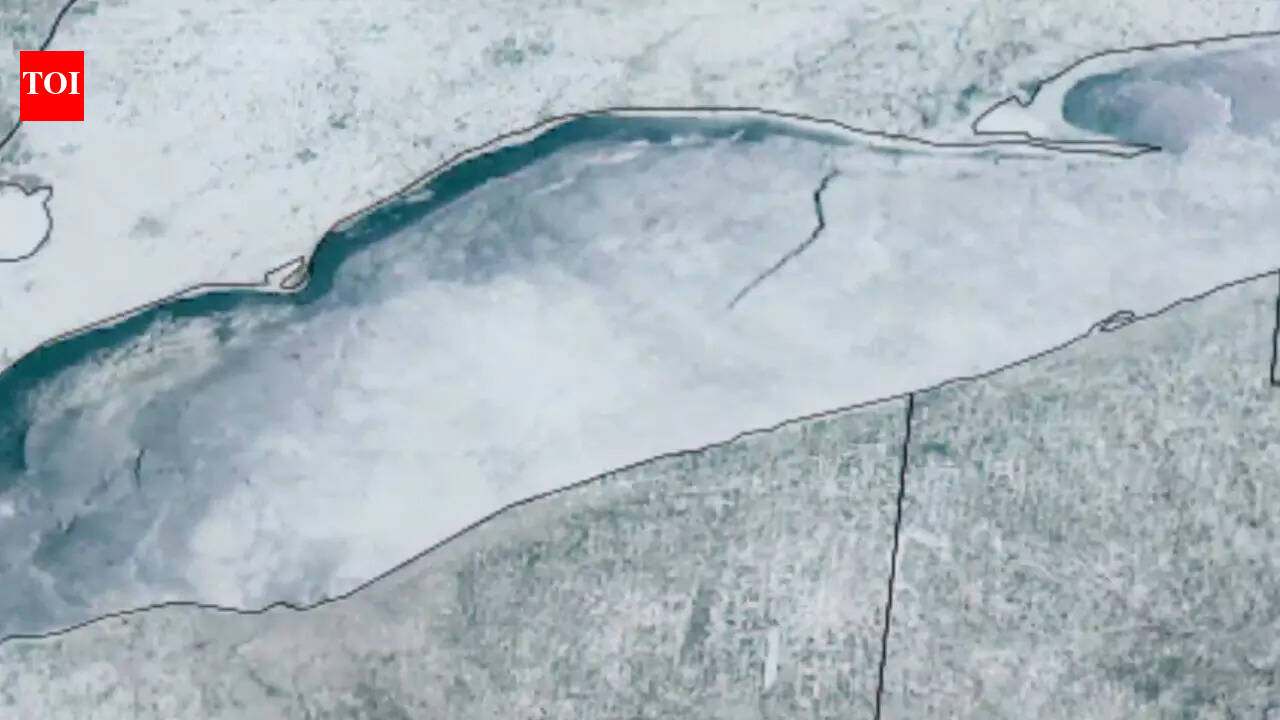
Lake Erie, one of North America’s largest lakes, has surprised everyone this week. A massive crack formed in the ice, stretching so far that it can reportedly be seen from space. People on the north shore in Canada could reportedly spot it all the way down to Cleveland, Ohio. The crack grew over Saturday, pushed by strong northerly winds. Ice shifted. Pressure built. Then snap. More than 80 miles of ice split. It’s a reminder that ice, no matter how thick, is never completely safe. Even on days when it seems solid, thin spots or sudden cracks can appear. Experts say this is exactly what’s happening on Lake Erie right now.
Satellite images show Lake Erie almost frozen, but cracks are growing
Around 95 percent of the lake is frozen, according to NOAA’s Great Lakes Environmental Research Laboratory. But the big crack might still expand. Temperatures are expected to rise slightly, which could make the ice weaker. Some forecasters say the chance of Lake Erie fully freezing over this winter seems to be slipping away.Complete freezing is rare. The lake has only completely frozen over three times in modern history, the most recent being 30 years ago, in 1996. Normally, winters see 65–70 percent ice coverage. Lately, the lake has come close a few times in 2025, 2018, 2015, 2014, and 2011 but never fully. Meteorologists are warning locals not to walk, snowmobile, or ice fish on the frozen lake. Even thick ice can hide weak spots. Aaron White, from 10 WBNS, reportedly said it’s a good reminder that ice safety is never guaranteed. People should stay cautious, no matter how solid it looks.It’s not just Erie. New York’s Hudson River also showed ice from satellites, after a cold snap left the city freezing. Temperatures there reportedly dropped lower than parts of Antarctica, feeling like -14 degrees with the wind chill. brutal. People walking outside probably wondered if they were ever going to thaw.
Why the ‘big crack’ happened
The big crack seems to be caused by wind pushing ice south. That builds pressure, which the frozen surface can’t always handle. Ice shifts, cracks appear for which the satellite images make it obvious how massive these splits can get. It’s kind of mesmerizing. You can almost see the lake breathing under the cold.Experts say this kind of cracking is normal when lakes approach near-total freeze. But it’s still dramatic to see something 80 miles long. Most of us never get to witness this scale firsthand. Even from space, it looks like a scar.
