



AI image (Picture credit: OpenAI via ChatGPT)
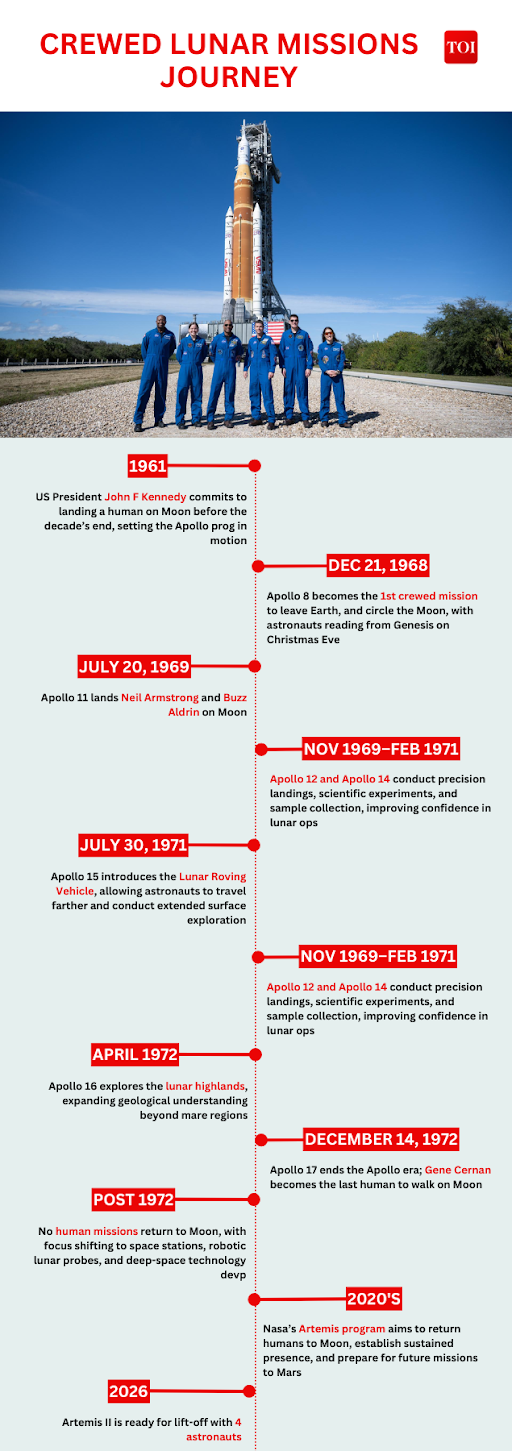
Four Artemis-II astronauts will return for a 10-day deep-space mission that’ll test new spacecraft, new partnerships and a new approach to lunar exploration“As I take man’s last step from the surface, back home for some time to come – but we believe not too long into the future – I’d like to just (say) what I believe history will record. That America’s challenge of today has forged man’s destiny of tomorrow. And, as we leave the Moon at Taurus-Littrow, we leave as we came, and, God willing, as we shall return, with peace and hope for all mankind”, said Eugene Cernan, the last man to have walked on Moon.These words from the Apollo 17 commander as he stepped off the lunar surface spoke of return, not retreat. History, however, unfolded differently. More than five decades have passed without another human venturing beyond low-Earth orbit.Apollo ended as much for political and scientific reasons as for cost. Analysis of lunar samples led US scientists to conclude that the Moon was dry and geologically inactive. With no evidence of water or usable resources, the case for sustained crewed missions weakened.That view changed decades later. Isro’s 2008 mission Chandrayaan-1 detected water molecules on the lunar surface. Later observations confirmed that water ice could exist in permanently shadowed regions near the poles. “A mass spectrometer on the moon impact probe on Chandrayaan-1 was the first instrument to have detected water in the South Pole region of the Moon. India played a crucial part in the global race back to the Moon,” whose lab at IISc has been working on building lunar bricks, in collaboration with Isro, says.This shift underpins Nasa’s Artemis program, which aims to move human spaceflight beyond short missions toward a longer-term presence around and on the Moon. The next step is Artemis II, the first crewed mission to travel beyond low-Earth orbit since Apollo.Earlier this week, several days after Nasa rolled the Space Launch System (SLS) rocket, stacked with the Orion spacecraft, to Launch Complex 39B at the Kennedy Space Center, Florida and four Artemis II astronauts, Reid Wiseman, Victor Glover, Christina Koch, and Jeremy Hansen, entered quarantine, a wet dress rehearsal showed leaks in the rocket, pushing the targeted launch window to March.
Meet the astronauts
Artemis II is designed as a lunar flyby rather than a landing mission. “Artemis II will be a momentous step forward for human spaceflight,” Nasa Administrator Jared Isaacman has said, calling the mission essential to returning humans safely to the Moon. And the four astronauts have several firsts among them.Reid Wiseman, a Nasa astronaut and US Navy aviator, will command Artemis II, bringing ISS expedition leadership, test pilot experience, and discipline to humanity’s first crewed lunar flyby in over five decades.Victor Glover, a Nasa astronaut and naval aviator, serves as pilot on the mission, drawing on SpaceX Crew-1 experience, systems engineering expertise, and operational flight hours from carrier-based aviation operations. Glover will become the first person of color to go to the Moon.Christina Koch, a NASA astronaut and engineer, flies as mission specialist, becoming first woman on a lunar mission, backed by record-setting ISS endurance and scientific research experience in orbit.Jeremy Hansen, a Canadian Space Agency astronaut and former fighter pilot, joins as mission specialist, marking Canada’s first lunar mission participation and bringing international collaboration to the crew effort.
The plan
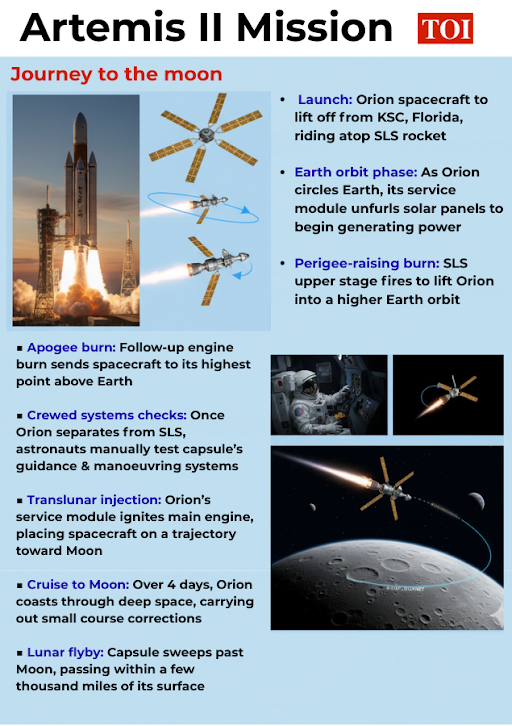
The mission will carry the astronauts aboard Orion, launched by SLS, the most powerful rocket Nasa has built. After lift-off, Orion will spend several days in Earth orbit before heading toward the Moon, traveling beyond lunar orbit, looping once around it, and returning to Earth. Unlike Artemis I, which flew uncrewed in Nov 2022, Artemis II will test the full system with astronauts onboard.Nasa describes the flight as a bridge between demonstration and landing. The mission will validate life-support, navigation, propulsion, communications and heat-shield performance in deep space. Astronauts will manually pilot Orion to test crew control in case automated systems fail, and recovery procedures after splashdown will be rehearsed.
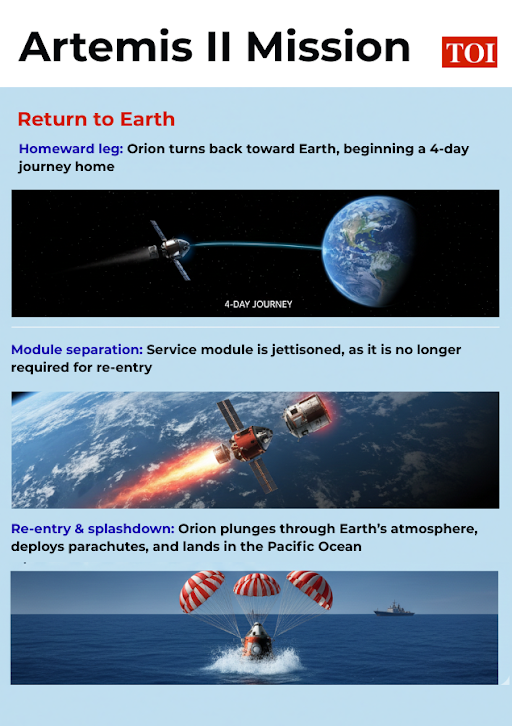
Beyond engineering, Artemis II carries symbolic weight. It marks humanity’s return to cislunar space, focused on rebuilding capability rather than spectacle. By flying a full lunar-distance mission without landing, NASA aims to reduce risk before committing crews to surface operations. More than 50 years after Eugene Cernan’s farewell, the path back to the Moon is cautious and deliberate.
why it matters
Artemis links the Apollo era with a future of sustained exploration. It matters because it re-establishes human capability in deep space and lays the foundation for living and working far from Earth.As the first crewed flight of Orion and SLS together, Artemis II will validate critical systems in the real deep-space environment. Proving these systems with astronauts onboard is essential before future lunar landings and, eventually, missions to Mars.Although it does not include a landing, Artemis II offers scientific value. Astronauts will observe lunar geology from close range, practice real-time science operations, and help refine how future crews conduct research beyond low-Earth orbit. These observations will inform planning for surface missions.The mission will also collect biomedical and environmental data on human health, radiation exposure and spacecraft performance beyond Earth’s magnetic field. This information is critical for designing safer spacecraft, planning longer lunar stays, and preparing for multi-year missions to Mars.
The science
During a three-hour flyby of the Moon’s far side, astronauts will analyze and photograph geologic features such as impact craters and ancient lava flows. Drawing on extensive geology training on Earth, they will describe shapes, textures and colors that reveal the Moon’s geologic history. These skills will be vital for future missions to the South Pole region.Artemis II is also Nasa’s first opportunity in 53 years to study how humans cope with deep space beyond low Earth orbit. At the core is ARCHeR (Artemis Research for Crew Health and Readiness), which examines sleep, stress, cognition and teamwork. Participating astronauts will wear wristband devices to track movement and sleep, with data combined with pre- and post-flight assessments to study behavior and decision-making.Immune health is another focus. Researchers will analyze saliva and blood samples collected before, during and after the mission to study immune responses under deep-space stressors such as radiation and isolation. Dry saliva samples will be stored on specialized paper, and scientists will look for signs of dormant virus reactivation.
AVATAR, a first-of-its-kind deep space demonstration of organ-on-a-chip technology beyond the Van Allen belts, will use bone marrow cells grown from each astronaut’s blood. These miniature models will help assess how radiation and microgravity affect human tissue and whether such chips can predict individual health risks.The crew will also take part in Spaceflight Standard Measures, providing biological samples and undergoing tests of balance, vision, cardiovascular health and brain function. Radiation exposure inside Orion will be tracked using personal dosimeters and upgraded sensors.Besides biomedical studies, astronauts will conduct a lunar observation campaign, photographing and describing the Moon from orbit. Human perception may reveal subtle surface features and guide future science. Together, these studies make Artemis II a foundational mission as NASA prepares for sustained lunar exploration and, eventually, Mars.
Change in technology
From Apollo to Artemis II, spaceflight technology has advanced across spacecraft design, computing, power, communications and mission planning.Orion is larger and more capable than Apollo’s command module, carrying up to four astronauts on longer missions with about 30% more habitable volume. Its life-support, exercise and waste-management systems are designed for extended flights.Apollo relied on a single flight computer with limited memory. Orion uses multiple redundant computers with far greater processing power, allowing onboard software to manage navigation and system health with minimal manual input.Apollo used fuel cells for power. Orion relies on solar arrays, enabling longer missions. It features digital displays, extensive sensors and more robust communications, with built-in redundancy to reduce the risk of single-system failures.SLS is the most powerful rocket NASA has built in decades, using modern materials and engineering methods. Artemis missions also rely on extensive uncrewed testing and integrated simulations before carrying astronauts, reflecting a more rigorous approach to mission readiness.
