



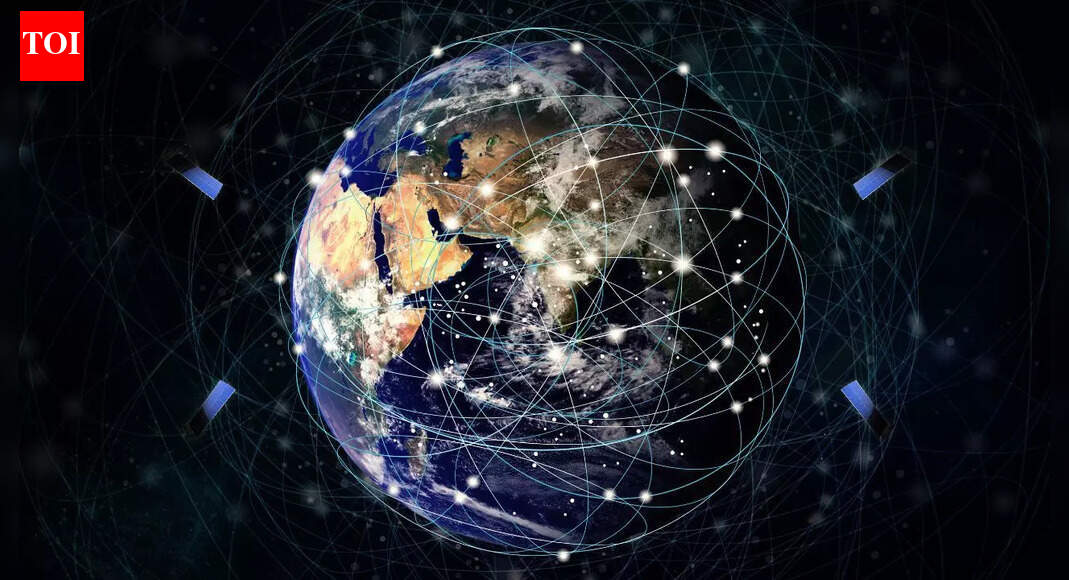

Observing the universe has always depended on dark skies, long exposures, and instruments designed to capture signals that are often barely distinguishable from background noise. This delicate balance is beginning to shift as satellite megaconstellations expand across low Earth orbit, increasing both in number and operational complexity. These networks support global communication services, navigation systems, and commercial connectivity, yet their growth introduces a new layer of activity that intersects with scientific exploration. Telescopes, whether stationed on the ground or positioned in orbit, now record more traces of passing satellites, and researchers are working to understand how this changing environment may influence the clarity and reliability of astronomical observations in the years ahead.
How bright satellites distort the view of the sky
The appearance of bright, fast-moving satellites in long exposure images has become a visible challenge across several observatories. A recent study published in Nature on megaconstellations and their impact examines how reflected sunlight creates luminous streaks that cut across critical observational frames. These streaks appear most frequently during twilight periods, when satellites remain illuminated even though the sky is dark enough for sensitive data collection. Wide field surveys that capture large portions of the sky at once are especially vulnerable, since each exposure covers a region where multiple satellites may pass simultaneously. This results in frames that need correction or removal, reducing the overall efficiency of survey missions. For astronomers tracking faint objects such as distant galaxies, small asteroids, or weak gravitational lensing patterns, even a single streak can compromise measurements that depend on clean, uninterrupted light. As megaconstellations expand, the probability of repeated interruptions increases, creating a long-term challenge that requires new operational strategies.
why radio telescopes struggle with growing orbital noise
Radio astronomy faces its own set of complications as new satellites transmit across a wide range of frequencies. Many of these frequencies lie close to, or overlap with, bands used for scientific observations, which increases the difficulty of isolating cosmic signals from human-generated noise. Radio telescopes are designed to detect emissions that may be billions of years old, and these signals can be exceptionally faint. When a satellite beam passes near a telescope’s field of view, even a small amount of leakage can overwhelm the data. The movement of thousands of satellites, each following different orbital paths, creates an evolving pattern of interference that cannot be fully anticipated. Traditional shielding methods reduce some of the impact, but scientists are now encountering situations in which electronically quiet zones are no longer sufficient. This affects studies of hydrogen distribution, black hole activity, pulsar timing, and the search for early universe signatures, all of which rely on sensitive, high-precision measurements. The complexity of balancing technology growth with the preservation of radio silence has become a major topic within international astronomy collaborations.
The complications of a crowded orbit for future telescopes
Space-based observatories have traditionally enjoyed clearer viewing conditions than their ground-based counterparts, yet this advantage is narrowing as low Earth orbit becomes increasingly dense. Navigating a crowded environment requires continuous monitoring and occasional avoidance maneuvers, which consume fuel and shorten mission lifetimes. Each telescope placed in orbit must now account for the presence of thousands of fast-moving objects whose trajectories shift frequently due to atmospheric drag and routine operational changes. This introduces logistical challenges for missions that depend on long exposures or stable pointing conditions. Scientific programs designed to observe transient events, such as sudden stellar outbursts or rapidly evolving supernovae, may face increased difficulty scheduling uninterrupted observational windows. Planning future missions involves identifying orbital regions that remain predictable and relatively unobstructed, a task that becomes more complex as commercial providers expand coverage across multiple altitude bands.
How light scatter and orbital debris affect long-term research
Beyond direct interference, satellites contribute to subtle changes in the overall brightness of Earth’s orbital environment. The surfaces of satellites scatter sunlight in ways that vary depending on their material, orientation, and operational state. Over time, this creates diffuse light that elevates the background level against which faint astronomical signals must be measured. Even small fragments produced through minor collisions or routine operations can reflect enough sunlight to appear in sensitive exposures. For researchers studying the earliest galaxies, weak cosmic structures, or delicate patterns of background radiation, these changes may reduce the accuracy of long-term datasets. Space debris also poses risks for active observatories, since even small particles can damage sensors that require extremely clean surfaces to function at full precision. Scientists are exploring mitigation approaches, such as improved satellite darkening methods and enhanced debris tracking systems, but these strategies rely on cooperation across multiple organizations and national agencies.
Why these changes matter for ongoing scientific discovery
The evolving orbital environment influences how astronomers plan, collect, and interpret data across many branches of research. Surveys that once relied on consistent conditions now require updated calibration methods that adjust for streaks, scattered light, and radio interference. Scientific models must incorporate new variables that describe satellite behavior, orbital density, and illumination patterns. These adjustments are essential for maintaining long-term accuracy, particularly in fields where trends are measured across decades. The relationship between communication infrastructure and scientific access to the sky continues to shift, highlighting the need for collaborative frameworks that balance technological development with the safeguarding of astronomical visibility. Researchers are now examining how best to retain the clarity of the night sky while accommodating rapid growth in orbital activity, a process that will shape the future of space-based discovery.Also Read | What explains a grand-design spiral galaxy only 1.5 billion years after the Big Bang
