




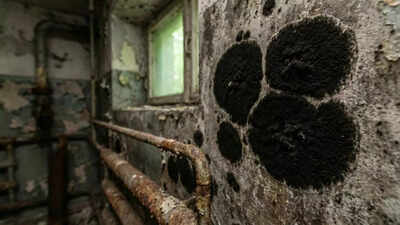
Life often finds surprising ways to adapt, even in places where survival seems impossible. Inside the abandoned ruins of Chernobyl’s destroyed nuclear reactor, scientists discovered a strange black fungus that not only survives extreme radiation but appears to grow toward it and possibly use it for energy. Scientists working with NASA’s space biology teams and researchers from Stanford University and the Albert Einstein College of Medicine have suggested that this radiation-eating fungus could one day help protect astronauts on Mars missions.
Chernobyl fungus and its unusual relationship with radiation
In 1997, Ukrainian mycologist Nelli Zhdanova entered the damaged Chernobyl reactor and found something unexpected. Black mold had spread across ceilings, walls and even inside protective metal conduits. Her surveys documented 37 fungal species, many of them dark because their cells were filled with melanin. The most dominant species, Cladosporium sphaerospermum, seemed to grow toward radioactive particles, a behavior Zhdanova called radiotropism. The fungus was behaving almost as if radiation was something it wanted.Melanin is the pigment that gives color to human skin and protects us from sunlight. In the Chernobyl fungi, melanin appears to play a much bigger role. It not only shields the fungus from damage but also absorbs and neutralises radiation. In 2007, nuclear scientist Ekaterina Dadachova found that melanised fungi grew about 10 percent faster when exposed to radioactive cesium than those kept without radiation. She suggested that the fungus might be using melanin to convert radiation into energy, a process called radiosynthesis. This idea is similar to photosynthesis in plants but powered by ionizing radiation instead of sunlight.Recently, scientists who study this fungus have revisited its strange abilities. In new commentary, researchers such as Nils Averesch at Stanford University, who has worked on radiation experiments involving C. sphaerospermum, emphasized that there is still no proof that the fungus truly “feeds” on radiation. He noted that while the organism clearly thrives in high-radiation environments and melanin behaves differently under ionizing radiation, the exact mechanism behind this advantage remains unknown. This renewed caution from experts has brought fresh attention to the fungus, highlighting how much of its biology is still a mystery.Melanin-based adaptation is not limited to fungi. Tree frogs living inside the Chernobyl zone have become noticeably darker than frogs living outside it. The darker frogs appear to survive better in contaminated areas, which suggests that melanin provides both protection and an evolutionary advantage.Not all studies agree. Some species at Chernobyl do not grow faster when exposed to radiation and some show no attraction to radioactive sources. A 2022 study from Sandia National Laboratories also found no growth difference in the fungi they tested. Because of this, radiosynthesis remains a theory. Scientists have not yet found a clear metabolic pathway or a biological mechanism that proves the fungus is turning radiation into energy. Even so, the behavior of C. sphaerospermum remains unusual and is still not fully understood.
Space experiments reveal extraordinary potential
In 2018, samples of the Chernobyl fungus were sent to the International Space Station. For 26 days, the fungus was exposed to high levels of cosmic radiation that are far stronger than anything on Earth.Researchers found that:
- The fungus grew faster in space
- A thin layer of the fungus blocked some cosmic radiation
- Sensors placed beneath the sample recorded lower radiation levels.
This suggested that the fungus could act as a natural radiation shield. Even a very thin layer had a measurable effect. Although some of the increased growth could have been caused by microgravity rather than radiation, the shielding ability itself was clear.
Why Mars missions need a solution like this
Radiation is one of the biggest dangers facing astronauts who travel to Mars. The planet has no protective magnetic field and only a thin atmosphere. This means astronauts would be exposed to constant cosmic rays that can damage cells, increase cancer risk and affect the brain.Traditional shielding such as metal walls is heavy and extremely expensive to launch. A living shield made from fungus could offer a new approach. The fungus grows on its own, repairs itself and can become thicker when radiation levels rise. Scientists imagine using fungal layers inside spacecraft or even building future Martian habitats with melanin-rich biological materials.
The Chernobyl disaster and its radioactive legacy
The Chernobyl disaster took place on 26 April 1986 during a late-night safety test at Reactor Four of the Chernobyl Nuclear Power Plant. A combination of design flaws in the reactor and critical human errors caused a sudden power surge, leading to explosions that tore through the building and ignited a fire that burned for days. The accident released enormous amounts of radioactive material across Ukraine, Belarus and parts of Europe. In response, authorities created a 30 kilometer exclusion zone to limit human exposure, an area that still contains some of the most radioactive hotspots on Earth.
A promising idea that still needs answers
Although the results are encouraging, researchers emphasize that much remains unknown. Radiosynthesis has not been proven and the fungus may be thriving for reasons other than using radiation as an energy source. Even so, the combination of radiotropism, rapid growth under radiation, melanin’s protective power and the space station experiments all point to a very unusual organism with remarkable properties.Whether the fungus is truly feeding on radiation or simply tolerating it unusually well, it has already shown an ability to block harmful rays. For astronauts heading to Mars, this strange mold from a nuclear wasteland could one day become a valuable protective tool, although far more research is needed before it becomes part of real mission designs.
